

🎁 How to apply the TRX Training Discount Code

This is a complete 30-minute TRX workout plan for the whole body: a 5-minute warm-up plus 15 exercises in 3 rounds, each round done twice.
You get sets, reps, rest times and the correct strap length for every move — and you can either follow the tables right here on your phone or download the free printable PDF.
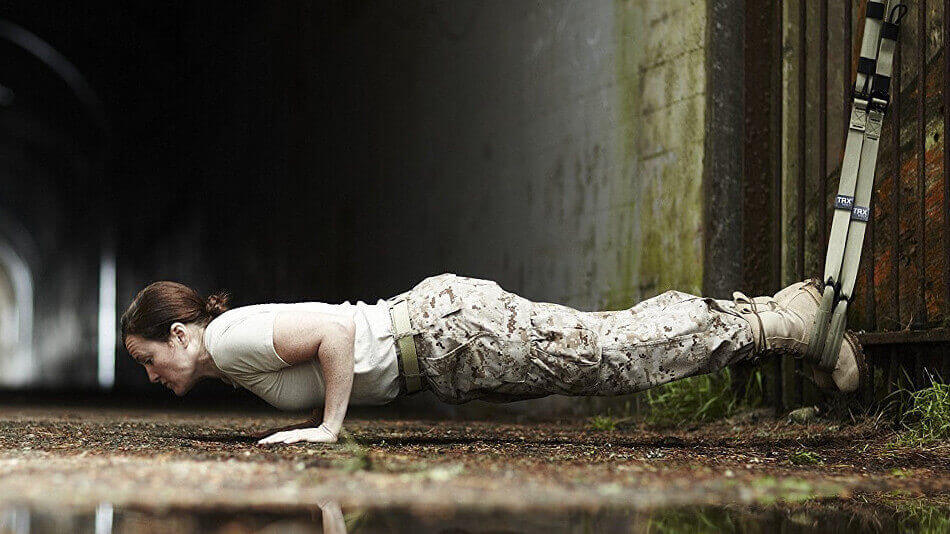
The whole plan is 15 exercises in three rounds, each round done twice, in 30 minutes.
No gym. No weights. One TRX Suspension Trainer and an anchor point.
Download the the printable PDF – TRX Workout Plan
Want the printable version to stick on the wall or take to the gym? It’s free, there’s no sign-up, and it fits on a single sheet.
↓↓↓ Download the TRX Workout here [PDF] ↓↓↓
The PDF gives you the plan. This page gives you everything the PDF can’t fit: the technique for each of the 15 moves, the mistake people make on it, how to make it easier or harder, and a four-week progression for when the plan stops feeling hard.
Who this TRX workout is for
This plan works for you if:
- You’ve used a suspension trainer at least a few times and know how to hang it safely
- You can hold a solid plank for 20 to 30 seconds
- You want to train the whole body in one session, two or three times a week
- You train at home, in a hotel room, in a garage or outdoors

The plan assumes you have used a suspension trainer before and know how to hang it safely.
Come back to this later if:
- It’s your first day with a suspension trainer and nobody has shown you how to anchor it — read how to anchor a TRX at home or outside first
- You’re recovering from a shoulder, wrist, elbow or lower back injury and haven’t been cleared to train
- You can’t yet hold your body in a straight line off the floor
Complete beginners get the most out of a handful of sessions with a qualified trainer before running a plan solo. If you’d rather learn the system properly, look at the TRX education courses.
- Both straps hang from one anchor point, so the tool itself is unstable. Your body has to supply the stability the equipment doesn’t.
- That job falls to the deep trunk musculature — transversus abdominis, the obliques, multifidus and the erector spinae — which brace to stop your spine and pelvis from moving.
- Because your feet or hands are in the straps, the load runs through a long lever from anchor to floor. The further your center of mass sits from your base of support, the more trunk bracing you need.
- So a chest press stops being a chest exercise. It becomes a chest exercise performed inside a moving plank.
Why it works: you’re not adding a separate core block at the end of the session. Core work is built into all 15 exercises, which is how a 30-minute session covers as much ground as it does.
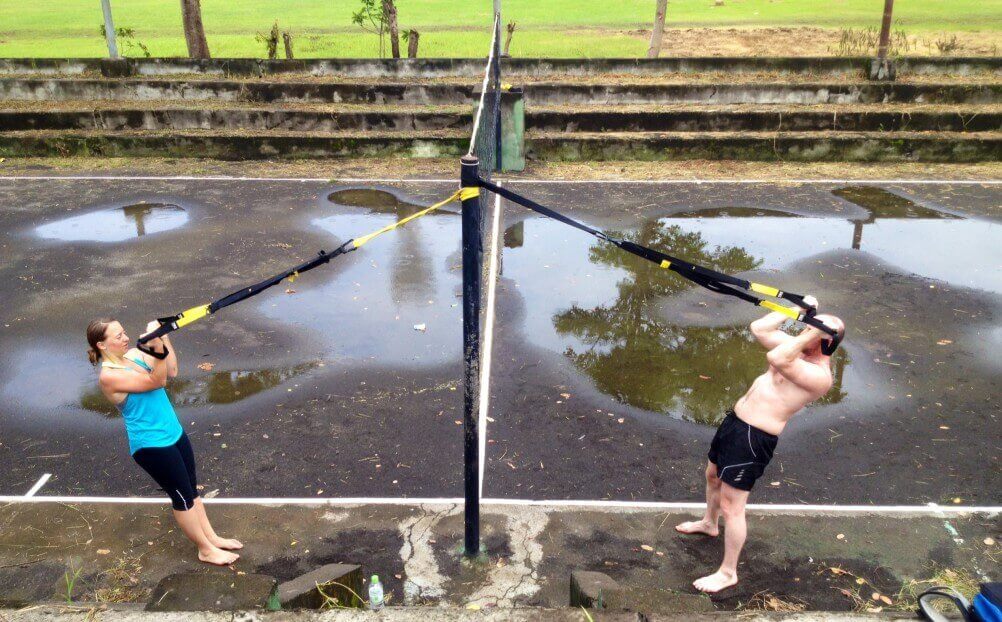
Anything that holds far more than your body weight works as an anchor — a door, a beam, a branch.
What you need before you start
- A suspension trainer. Any current model runs this plan. If you’re choosing one, see the TRX Suspension Trainer comparison. If you’re buying secondhand, check the genuine vs counterfeit guide first — a strap that fails mid-rep is not a theoretical problem.
- An anchor point rated for far more than your bodyweight, with about 6 to 8 feet (1.8 to 2.4 m) of clear space in front of it and 1 to 2 feet (30 to 60 cm) either side.
- Roughly 8 feet (2.4 m) of ceiling height for the overhead moves.
- A mat or towel for the floor-based exercises.
💡 Before every session, check the straps for fraying, check the anchor is solid, and make sure the straps aren’t twisted. A twisted strap pulls unevenly through the D-ring.

Check the anchor before every session — it has to take far more than your body weight.
Strap length: the five settings you’ll use
Every exercise in this plan tells you a strap length. These are the five settings, and the yellow embroidered marks on the straps are your guide.
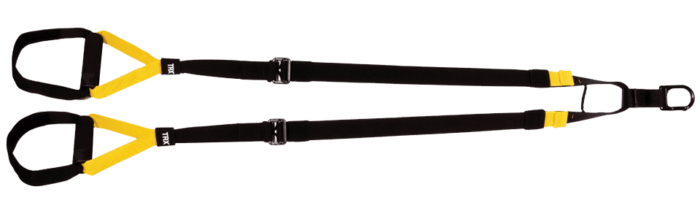
The yellow embroidered marks are how you hit the same strap length twice.
| Setting | How to set it | Used in this plan for |
|---|---|---|
| Long | Fully lengthened, bottom of each foot cradle about 3 inches (7.6 cm) off the floor | Chest Press |
| Mid-length | Adjustment tabs at the middle of the main strap — the double yellow mark | Biceps Curl, Triceps Press, Power Pull, Sprinter Start, Crossing Balance Lunge, Standing Rollout, Standing Hip Drop |
| Mid-calf | Bottom of each foot cradle at mid-calf height, roughly 8 to 12 inches (20–30 cm) off the floor | Hamstring Curl, Suspended Lunge, Hip Press, Mountain Climber, Hamstring Runner, Atomic Push-up |
| Short | Fully shortened, adjustment tabs at the top of the main strap — the single embroidered mark | Low Row |
| Over-short | From fully short, depress the cam buckles and pull the outside strap up to the locking loop | Not used in this plan — it’s the pull-up setting |
💡 Your height changes the feel of every setting. Treat the marks as the starting point, not the law. If a setting puts your hands or feet in an awkward place, adjust half an inch and note it down.
The warm-up: 5 minutes
Don’t skip it. The point is to raise tissue temperature and take your ankles, hips and shoulders through the range you’re about to load. Move with control — this isn’t a place to swing around and “loosen up.”

Five minutes of dynamic work: move through the range you are about to load, don’t hold stretches.
| Exercise | Reps | Strap length | What it opens up |
|---|---|---|---|
| TRX Assisted Squat | 10 slow | Mid-length | Ankles, knees, hips |
| TRX Assisted Hip Hinge | 10 | Mid-length | Hamstrings, hip hinge pattern |
| TRX Chest Opener | 8 each side | Mid-length | Chest, front of shoulder, thoracic spine |
| TRX Overhead Back Extension | 8 | Long | Lats, shoulders, upper back |
| TRX Assisted Lunge | 6 each leg | Mid-length | Hip flexors, glutes, single-leg balance |
| TRX Squat to Row | 10 | Mid-length | Whole chain, raises heart rate |
Keep the tempo steady and the straps taut. If you like a longer mobility block, read up on dynamic versus static stretching — dynamic work belongs before training, the long static holds belong after.
The 30-minute TRX workout plan
Three rounds. Repeat each round twice before moving to the next one. Warm-up plus six working blocks lands you at roughly 30 minutes, depending on how long you rest.
Each exercise name links to its full technique further down the page.
Three rounds, each repeated twice. Warm-up plus six blocks lands at about 30 minutes.
Round 1 — upper body pull and push
| # | Exercise | Sets | Reps | Rest | Strap length |
|---|---|---|---|---|---|
| 1 | TRX Low Row | 2 | 10 | 15 sec | Short |
| 2 | TRX Chest Press | 2 | 10 | 15 sec | Long |
| 3 | TRX Biceps Curl | 2 | 10 | 15 sec | Mid-length |
| 4 | TRX Triceps Press | 2 | 10 | 15 sec | Mid-length |
| 5 | TRX Power Pull | 2 | 5 each side | 1 min | Mid-length |
🔁 Repeat the round, then move on.
Round 2 — legs and posterior chain
| # | Exercise | Sets | Reps | Rest | Strap length |
|---|---|---|---|---|---|
| 6 | TRX Sprinter Start | 2 | 5 each leg | 15 sec | Mid-length |
| 7 | TRX Hamstring Curl | 2 | 10 | 15 sec | Mid-calf |
| 8 | TRX Suspended Lunge | 2 | 5 each leg | 15 sec | Mid-calf |
| 9 | TRX Hip Press | 2 | 10 | 15 sec | Mid-calf |
| 10 | TRX Crossing Balance Lunge | 2 | 5 each leg | 1 min | Mid-length |
🔁 Repeat the round, then move on.
Round 3 — core and full body
| # | Exercise | Sets | Reps | Rest | Strap length |
|---|---|---|---|---|---|
| 11 | TRX Standing Rollout | 2 | 10 | 15 sec | Mid-length |
| 12 | TRX Standing Hip Drop | 2 | 5 each side | 15 sec | Mid-length |
| 13 | TRX Mountain Climber | 2 | 10 each leg | 15 sec | Mid-calf |
| 14 | TRX Hamstring Runner | 2 | 10 each leg | 15 sec | Mid-calf |
| 15 | TRX Atomic Push-up | 2 | 10 | 1 min | Mid-calf |
🔁 Repeat the round. You’re done.
↓↓↓ Download the TRX Workout here [PDF] ↓↓↓
Technique for all 15 exercises
The single biggest variable in suspension training isn’t how many reps you do. It’s your body angle. Move your feet closer to the anchor and the exercise gets harder. Step them back and it gets easier. That’s the lever you use first — before you add reps, sets or sessions.
1. TRX Low Row
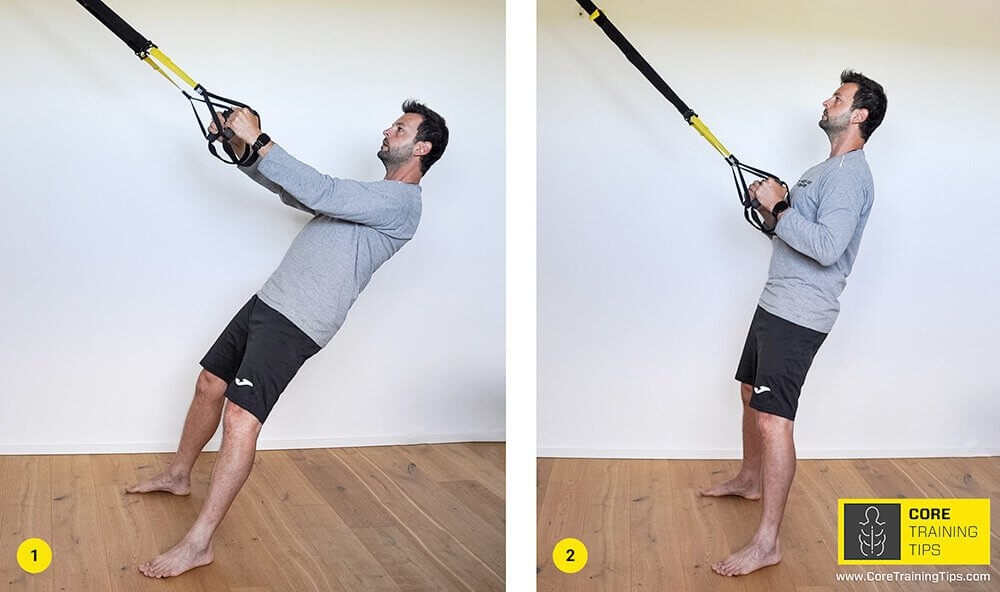
Adjustment: Short · Start position: Standing, facing the anchor
Exercise benefits: Loads the lats, rhomboids, mid-traps, rear delts and biceps in their strongest pulling position, and it’s the counterbalance to all the pressing and desk-sitting most people do.
Exercise technique:
- Face the anchor, grips in each hand, palms facing each other.
- Walk your feet forward and lean back until the straps are taut and your arms are straight.
- Brace your trunk so your body is one straight line from ears to heels.
- Pull your elbows past your ribs, driving from the shoulder blades, not the hands.
- Finish with your chest between the grips, then lower under control to straight arms.
Common mistakes:
- Hips sag or pike — you’ve lost the plank
- Pulling with the arms and letting the shoulder blades stay stuck
- Shrugging the shoulders up toward the ears
- Slack straps at the bottom of the rep
Easier: Step your feet back so your torso is more upright. Harder: Walk your feet toward the anchor until your body is closer to horizontal, or go to a single-arm row.
2. TRX Chest Press
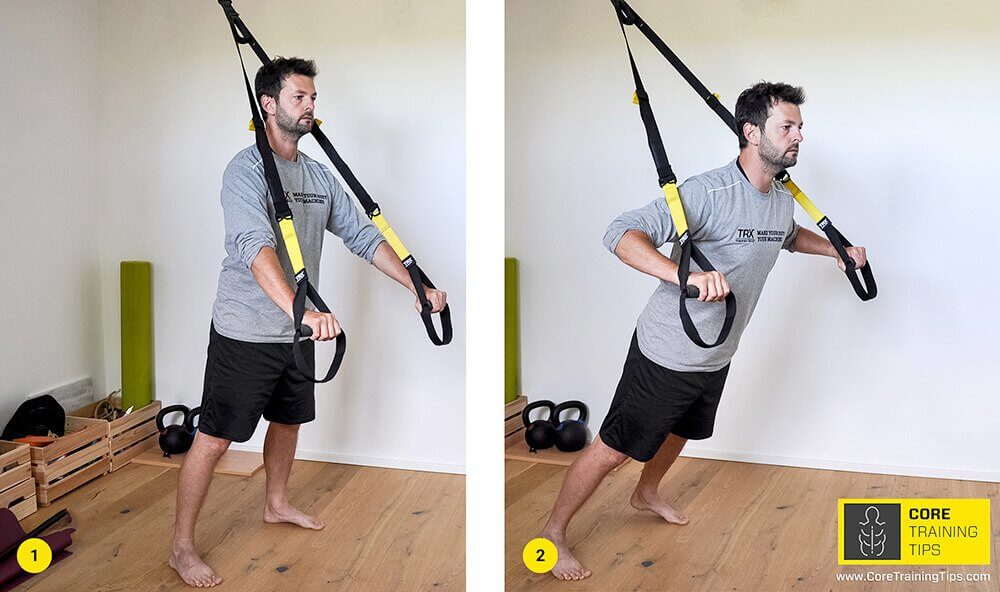
Adjustment: Long · Start position: Standing, facing away from the anchor
Exercise benefits: Works the pecs, anterior delts and triceps while the trunk fights to keep you rigid. It’s a push done inside a moving plank.
Exercise technique:
- Face away from the anchor with a grip in each hand, arms extended forward at chest height.
- Walk your feet back and lean forward onto the straps, body in one line.
- Lower your chest between your hands, elbows tracking at about 45 degrees from your ribs.
- Stop when your hands are level with your chest.
- Press back to the start without letting your hips lead or lag.
Common mistakes:
- Hands too low, so the straps rub the forearms — raise your arms slightly and the straps run free
- Hips dropping toward the floor as fatigue sets in
- Flaring the elbows straight out to the sides
- Bouncing out of the bottom instead of pressing
Easier: Step closer to the anchor for a more upright angle. Harder: Walk further back, or narrow your stance. For more on loading the back of the arm, see the TRX triceps exercises.
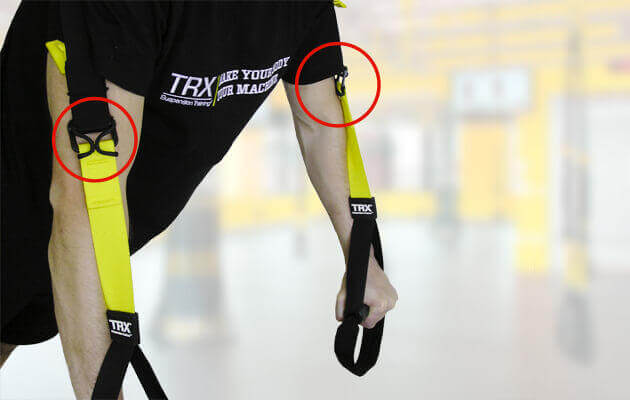
Move hands higher to prevent rubbing
3. TRX Biceps Curl
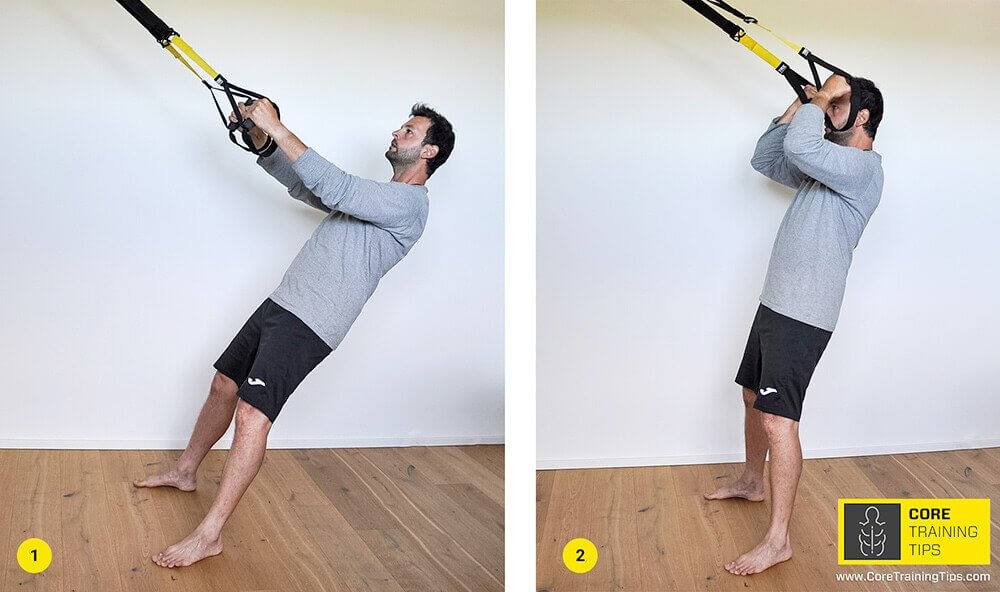
Adjustment: Mid-length · Start position: Standing, facing the anchor
Exercise benefits: Loads the biceps and forearms while the postural muscles hold your body in a straight line. Unlike a dumbbell curl, you can’t cheat with your lower back.
Exercise technique:
- Face the anchor, palms up, arms straight, leaning back with taut straps.
- Raise your elbows so your upper arms are in line with your shoulders.
- Keeping the elbows exactly where they are, curl your body up toward your hands.
- Pause when your hands reach your temples.
- Lower under control until your arms are straight again.
Common mistakes:
- Elbows dropping as you tire — it turns the curl back into a row
- Hips leading the movement instead of the arms
- Only going halfway down and never reaching straight arms
Easier: More upright body angle. Harder: Step toward the anchor, or slow the lowering phase to three seconds. More variations in the guide to TRX biceps exercises.
4. TRX Triceps Press
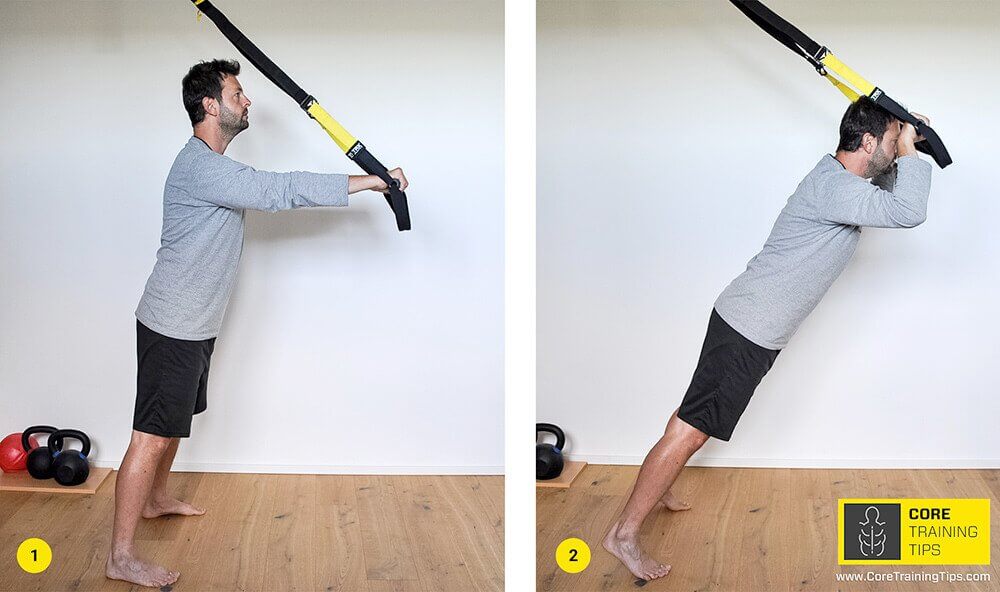
Adjustment: Mid-length · Start position: Standing, facing away from the anchor
Exercise benefits: Isolates the triceps as much as suspension training ever isolates anything, while demanding total body stability to stop your hips folding.
Exercise technique:
- Face away from the anchor, arms extended forward, palms down.
- Lean forward until the straps are taut and your body is in a straight line.
- Bend only at the elbows, lowering your forehead toward your hands.
- Keep the upper arms fixed and pointing straight ahead, elbows shoulder-width.
- Press back to straight arms without letting your hips drop.
Common mistakes:
- Elbows flaring wide, which turns it into a press
- Pushing the hips backward to make the rep easier
- Letting the shoulders move so it becomes a pullover
Easier: Stand more upright. Harder: Step your feet further back so you’re closer to horizontal.
5. TRX Power Pull
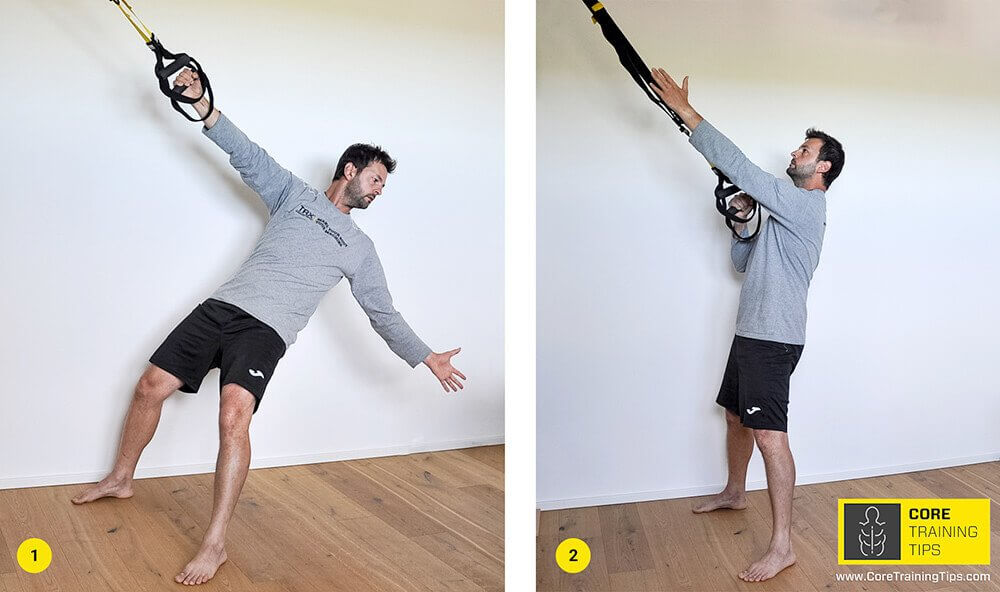
Adjustment: Mid-length, single handle mode · Start position: Standing, facing the anchor
Exercise benefits: One of the foundational rotation patterns. It gives you a large arc of motion that ties back strength to trunk rotation — the same pattern as swinging a golf club or lifting a child onto your hip.
Exercise technique:
- Hold one grip with your working hand, other hand reaching lightly toward the anchor.
- Lean back with taut straps, feet slightly wider than hip-width for balance.
- Open your body toward the floor, reaching the free hand back and down as you rotate.
- Reverse it: pull with the working arm and rotate back to face the anchor.
- Finish square, chest and hips facing the anchor. Complete all reps, then switch.
Common mistakes:
- Turning it into an arm exercise instead of driving from the back and trunk
- Reaching with the hand but never rotating the ribcage
- Losing the plank so the hips twist independently of the shoulders
Easier: Reduce the lean and rotate less far. Harder: Step toward the anchor and reach all the way to the floor.
6. TRX Sprinter Start
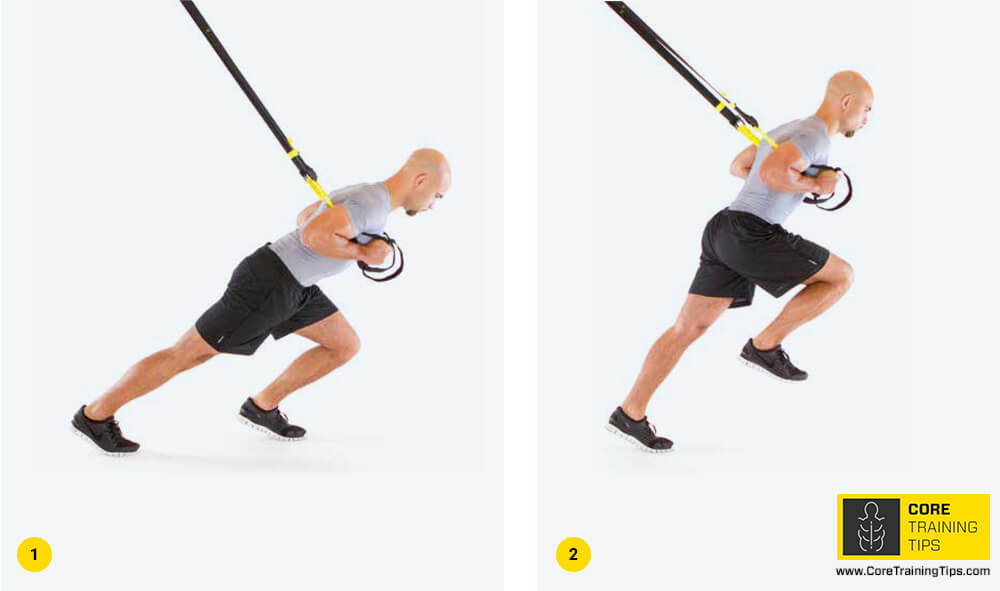
Adjustment: Mid-length · Start position: Standing, facing away from the anchor
Exercise benefits: Trains single-leg drive through quads, glutes and calves, with the hamstrings, hip flexors and lower back holding the forward lean.
Exercise technique:
- Face away from the anchor with a grip in each hand, arms at your sides.
- Lean forward until your body is at roughly 45 degrees to the floor, weight through the balls of your feet.
- Step one leg back and bend the knee to about 90 degrees, like a sprinter in the blocks.
- Drive hard through the front foot to return to the leaning start position.
- Complete all reps on one leg, then switch.
Common mistakes:
- Standing too upright, which removes the forward lean the exercise depends on
- Hanging on the straps with the arms instead of holding the line with the trunk
- Front heel lifting or the knee collapsing inward
Easier: Reduce the lean toward vertical. Harder: Increase the lean, or add a small hop at the top.
7. TRX Hamstring Curl
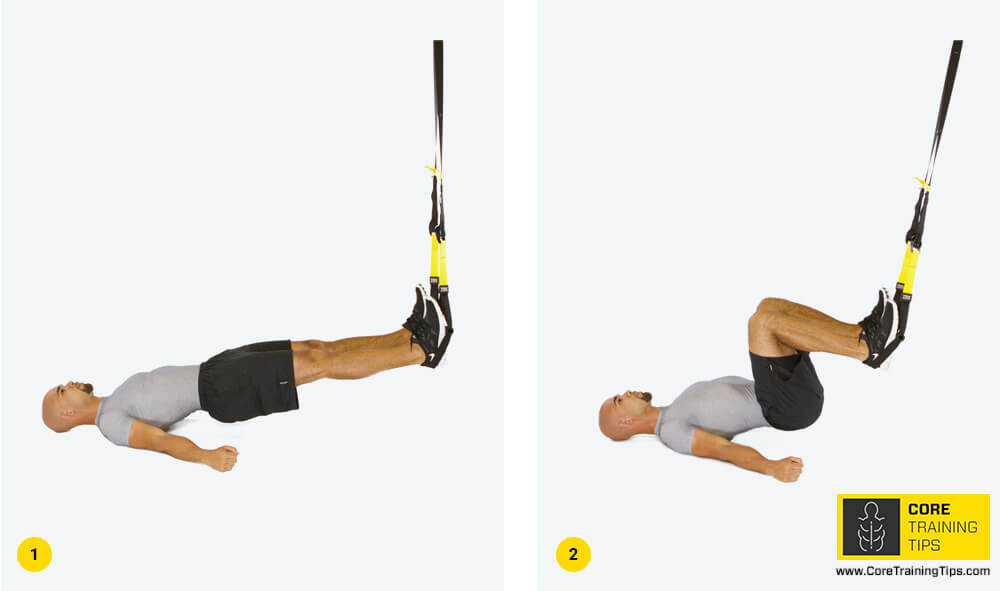
Adjustment: Mid-calf · Start position: Lying on your back, heels in the foot cradles
Exercise benefits: One of the few home exercises that loads the hamstrings in knee flexion. Glutes, hips and trunk work throughout to keep the bridge up.
Exercise technique:
- Lie on your back with your heels in the cradles, directly under the anchor point.
- Press your heels down, squeeze your glutes and lift your hips into a straight line from shoulders to knees.
- Holding that line, pull both heels toward your glutes.
- Keep even pressure in both foot cradles the whole way.
- Extend your legs back out slowly without letting your hips touch the floor.
Common mistakes:
- Hips dropping as the knees bend, so the hamstrings never really load
- Uneven pressure in the cradles, which lets one strap slip
- Rushing the return — the lowering phase is where most of the work is
Easier: Keep your hips on the floor and just curl the heels in. Harder: Do it one leg at a time, with the free leg held straight in the air.
8. TRX Suspended Lunge
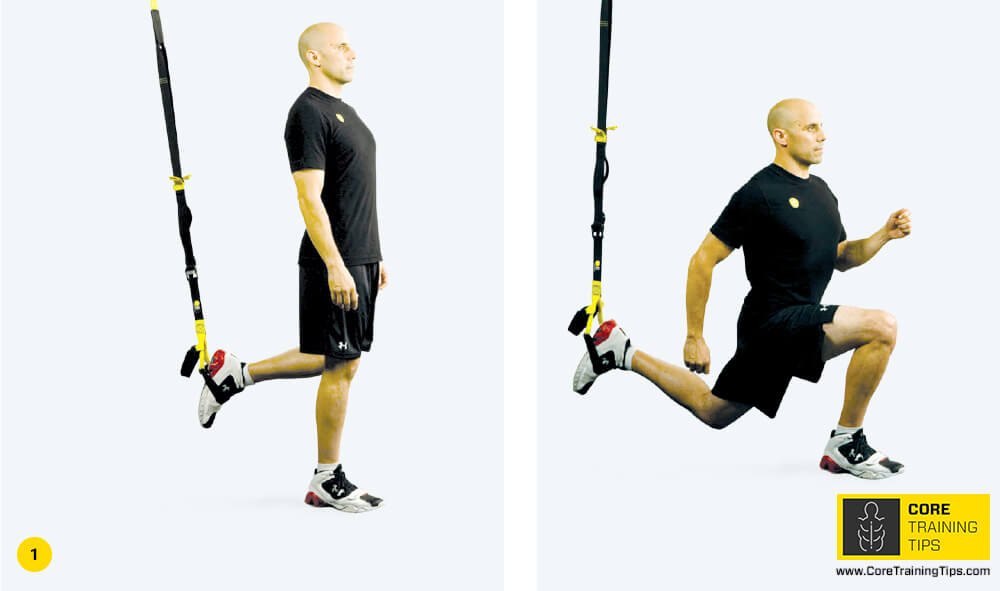
Adjustment: Mid-calf · Start position: Standing, facing away from the anchor, one foot in a cradle
Exercise benefits: A hands-free single-leg exercise that loads the front leg’s quads and glutes while the trunk and hip stabilizers stop you from tipping sideways.
Exercise technique:
- Face away from the anchor and place one foot in a single cradle behind you, laces down.
- Hop the standing foot forward so the suspended leg trails behind your hip.
- Hands on hips or out to the sides for balance. Stand tall.
- Lower straight down, bending the front knee, letting the back leg travel behind you.
- Drive through the front heel back to standing. All reps on one side, then switch.
Common mistakes:
- Standing foot too close to the anchor, so you fall forward on every rep
- Front heel lifting off the floor
- Leaning the torso forward instead of dropping vertically
Easier: Hold a wall or doorframe with one hand. Harder: Pause two seconds at the bottom, or add a hop out of it. More single-leg work in 3 TRX exercises for strong and explosive legs.
9. TRX Hip Press
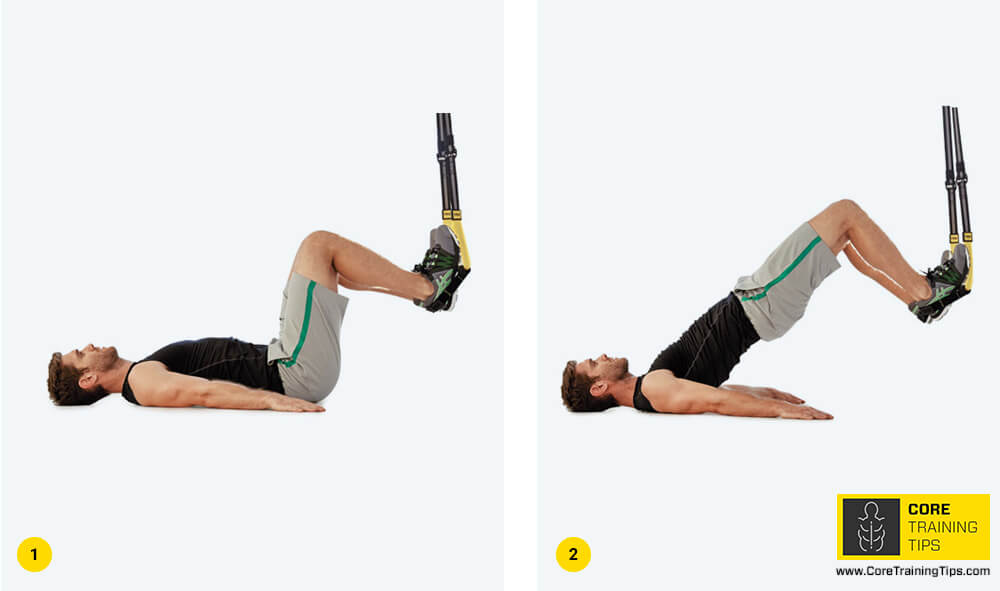
Adjustment: Mid-calf · Start position: Lying on your back, heels in the foot cradles
Exercise benefits: Targets the glutes, hamstrings and back extensors through hip extension. It’s the hinge pattern trained from the floor, which is friendly on the lower back.
Exercise technique:
- Lie on your back, heels in the cradles, knees bent to roughly 90 degrees.
- Arms out to the sides, palms down.
- Drive your heels down into the cradles and press your hips straight up.
- Finish in a line from shoulders to knees, glutes fully squeezed.
- Lower slowly. Keep the same knee angle from start to finish.
Common mistakes:
- Straightening the knees on the way up, which turns it into a different exercise
- Arching the lower back instead of extending at the hip
- Dropping fast and bouncing off the floor
Easier: Reduce the range and pause at the top. Harder: Press with one leg at a time.
10. TRX Crossing Balance Lunge
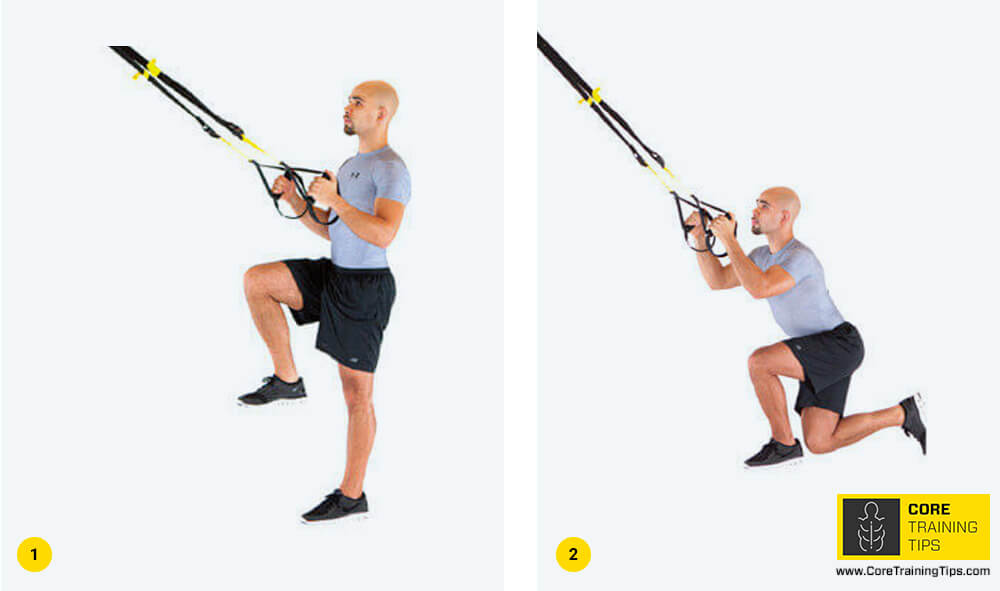
Adjustment: Mid-length · Start position: Standing, facing the anchor
Exercise benefits: The crossing-back path loads the glute medius and the rotational strength of the hip, and it builds hip mobility in a plane most home programs never touch.
Exercise technique:
- Face the anchor, a grip in each hand, arms extended, straps taut.
- Stand on one leg, chest tall.
- Cross the free leg back and across behind the standing leg, opening and rotating the hip as far back as you comfortably can.
- Bend the standing knee as the free leg travels back.
- Drive through the standing heel to return to the start. All reps, then switch.
Common mistakes:
- Hanging body weight on the straps instead of using them for balance
- Letting the standing knee collapse inward
- Crossing behind without any hip rotation, so it becomes a curtsy with no benefit
Easier: Shorten the cross-back and keep more weight in the straps. Harder: Lighten the grip until your fingers barely touch.
11. TRX Standing Rollout
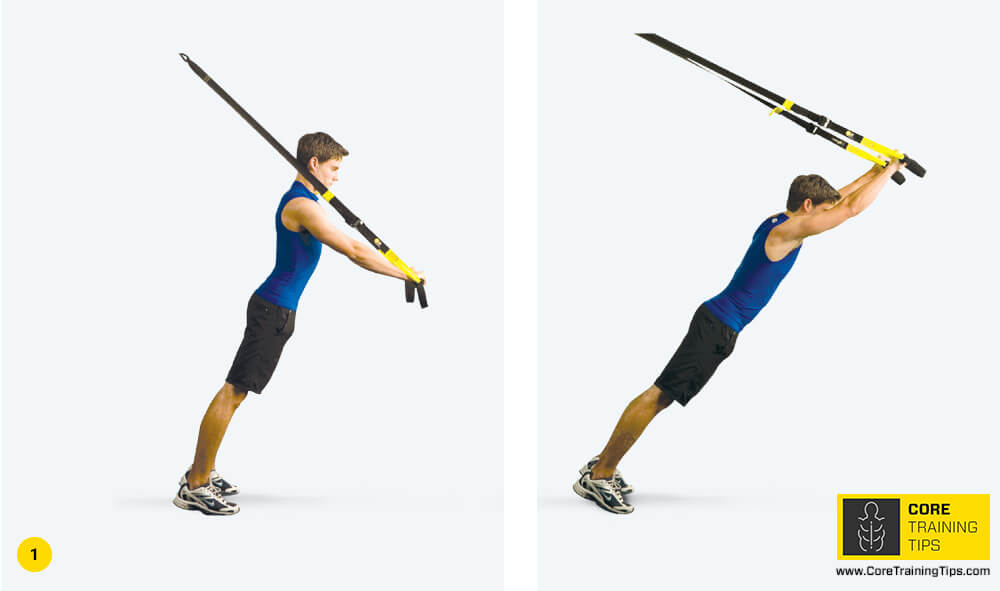
Adjustment: Mid-length · Start position: Standing, facing away from the anchor
Exercise benefits: A standing anti-extension exercise. The abdominals and the whole anterior chain fight to stop your lower back arching as your arms travel overhead.
Exercise technique:
- Face away from the anchor, a grip in each hand, arms extended forward.
- Lean forward onto the straps, body in one straight line.
- Tuck the tailbone slightly and draw the navel toward the spine.
- Keeping your arms straight, let your hands travel forward and overhead, lowering your body.
- Go only as far as you can without the lower back arching, then pull back to the start.
Common mistakes:
- Lower back arching at the far end of the rollout — that’s the rep limit, respect it
- Bending the elbows to shorten the lever
- Hips piking backward on the return
Easier: Stay upright and shorten the range. Harder: Step further back and go further overhead.
12. TRX Standing Hip Drop
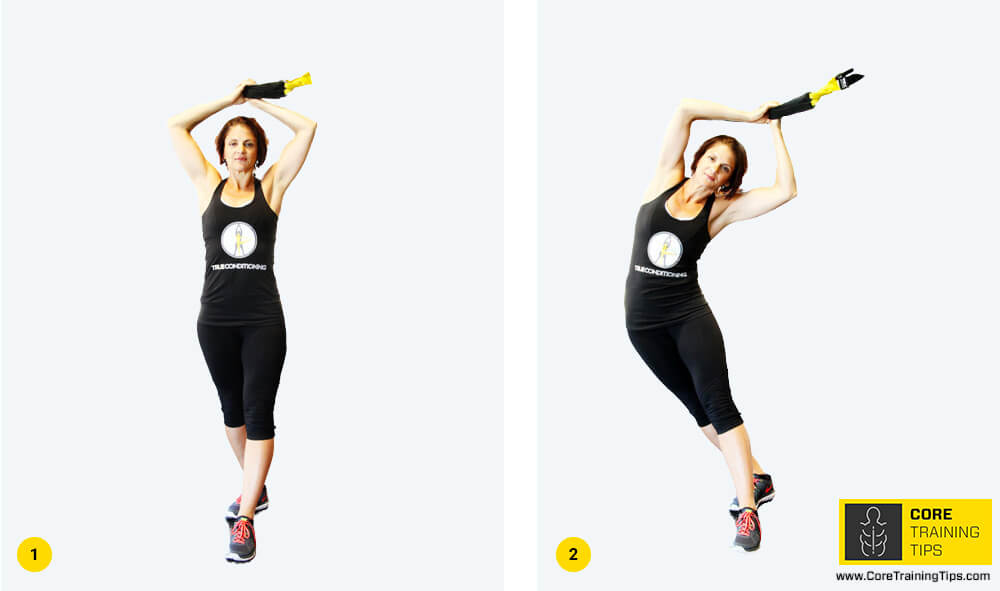
Adjustment: Mid-length · Start position: Standing side-on to the anchor
Exercise benefits: Loads the obliques and the lateral hip while adding side-to-side hip mobility — a plane that squats, presses and rows all ignore.
Exercise technique:
- Stand side-on to the anchor, both hands stacked on the grips, arms extended.
- Lean away from the anchor so the straps are taut and your body is at an angle.
- Keep your chest and hips facing the same direction throughout.
- Drop your outside hip toward the floor without twisting.
- Pull the hip back up using your side, not your arms. All reps, then face the other way.
Common mistakes:
- Twisting so the chest and hips end up facing different directions
- Pulling with the arms instead of the obliques
- Standing too upright, which removes the load
Easier: Stand more upright and reduce the drop. Harder: Increase the lean, or narrow your stance.
13. TRX Mountain Climber
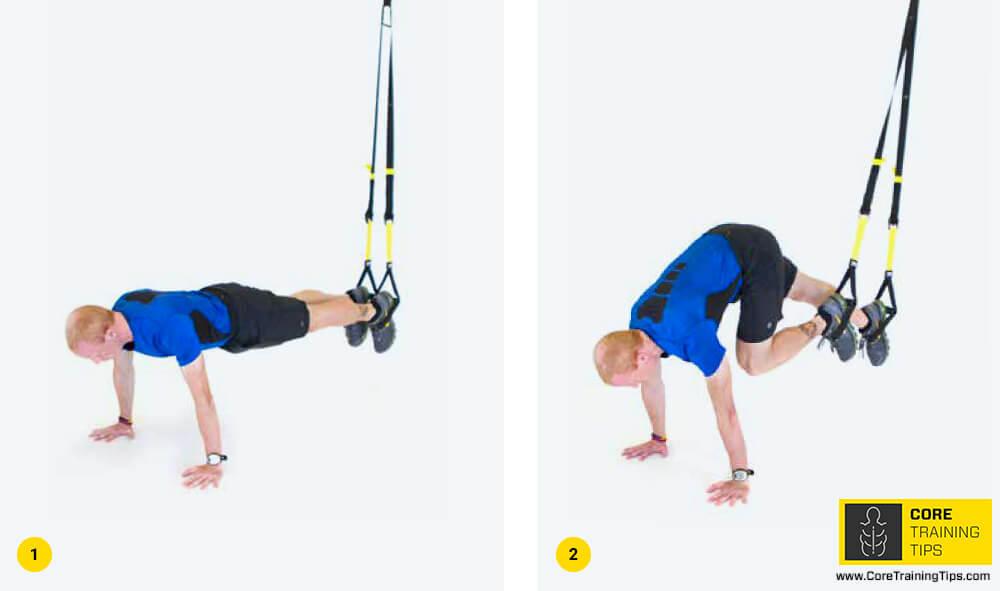
Adjustment: Mid-calf · Start position: Plank, both feet in the foot cradles
Exercise benefits: Combines a demanding plank with repeated hip flexion. Trunk, shoulders and hip flexors all work at once, and the heart rate climbs fast.
Exercise technique:
- Put both feet in the cradles and walk your hands out to a plank, wrists under shoulders.
- Set the plank: glutes squeezed, ribs down, one line from head to heels.
- Keep even tension in both foot cradles.
- Drive one knee toward your chest, then return it as the other knee drives in.
- Keep the hips low and level. Don’t let them bounce up with each rep.
Common mistakes:
- Hips rising into a pike with every knee drive
- Lower back sagging when the tempo picks up
- Uneven cradle tension, which lets one strap slide
Easier: Slow down and drive one knee at a time with a pause between. Harder: Increase the tempo, or drive the knee across toward the opposite elbow.
14. TRX Hamstring Runner
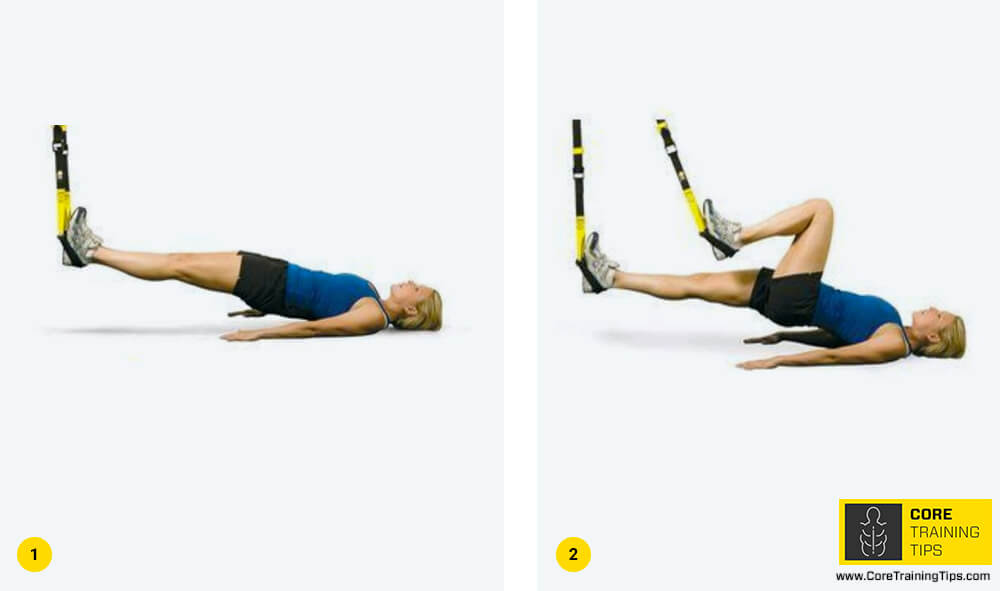
Adjustment: Mid-calf · Start position: Lying on your back, heels in the foot cradles
Exercise benefits: Builds the posterior chain — hamstrings, glutes and lower back — while exposing left-to-right imbalances that a two-legged bridge hides.
Exercise technique:
- Lie on your back with your heels in the cradles, directly under the anchor.
- Drive your heels down, squeeze your glutes and brace to lift your hips. Think of it as a plank on your back.
- Without letting the straps slip, draw one knee toward you.
- Keep the other leg dead straight — that’s the leg that matters.
- Switch legs in a controlled running rhythm, hips staying high throughout.
Common mistakes:
- Focusing on the moving leg and letting the straight leg drop
- Hips sinking to the floor mid-set
- Straps slipping because the pressure in the cradles is uneven
Easier: Cut the reps and rest the hips on the floor between them. Harder: Add a pause with one knee held in.
15. TRX Atomic Push-up
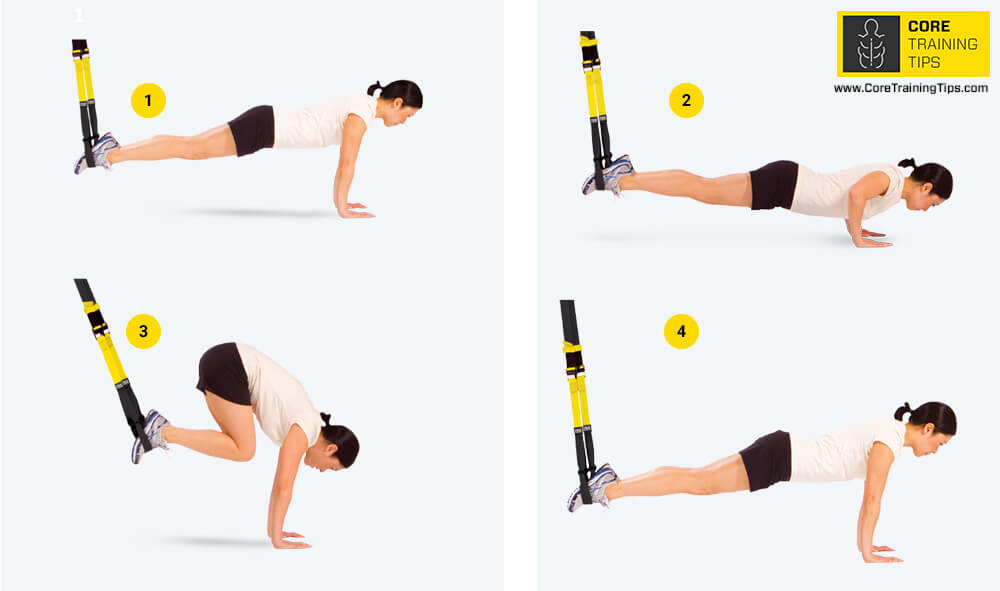
Adjustment: Mid-calf · Start position: Plank, both feet in the foot cradles
Exercise benefits: A push-up and a knee tuck in one rep. High intensity, full body, and a fitting last exercise in the session.
Exercise technique:
- Feet in the cradles, hands on the floor under your shoulders, body in a plank.
- Perform a full push-up, chest to just above the floor, elbows at about 45 degrees.
- Press back up to a straight-arm plank.
- Drive your tailbone up and pull both knees in toward your chest.
- Extend the legs back to the plank. That’s one rep.
Common mistakes:
- Skipping the full push-up depth once the set gets hard
- Pulling the knees in with the hip flexors only, with no lift of the tailbone
- Wrists collapsing — set your hands before you start, not mid-set
Easier: Split it — do the push-ups and the knee tucks as two separate exercises. Harder: Add a pike at the top of the tuck.
Train safe: the five rules that apply to every exercise
Each exercise above has its own common mistakes. These five apply across the whole session.
- Set your position before the first rep, not during it. Find your feet and your body line first. Jerky starts are where back strains happen.
- Never grind out a rep you can’t control. Walk your feet back from the anchor, reduce the angle between your body and the floor, and finish the set clean. That’s not quitting — it’s how the tool is designed to work.
- Keep the straps taut from the first rep to the last. Slack straps cut the tension out of the movement.
- Keep even pressure on both grips so the straps can’t slide through the loop.
- Level the yellow marks on both straps. If they aren’t level, one side carries more load than the other.
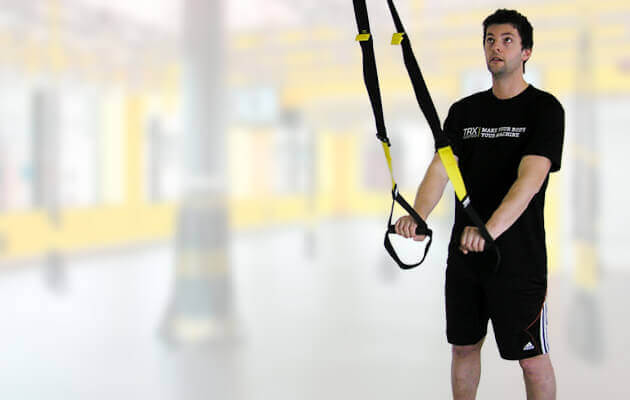
Set your body line before the first rep — jerky starts are where back strains happen.
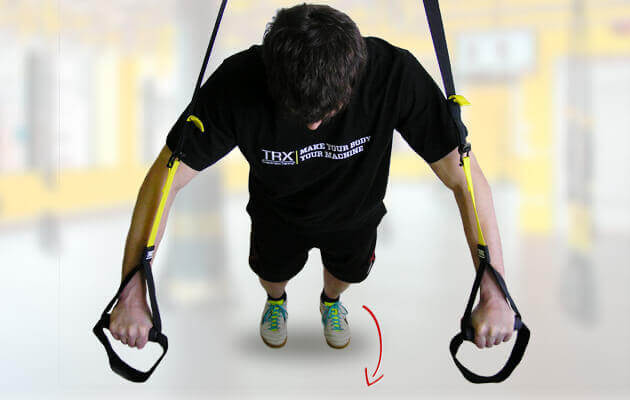
If you can’t finish a rep in control, walk your feet back and reduce the angle.
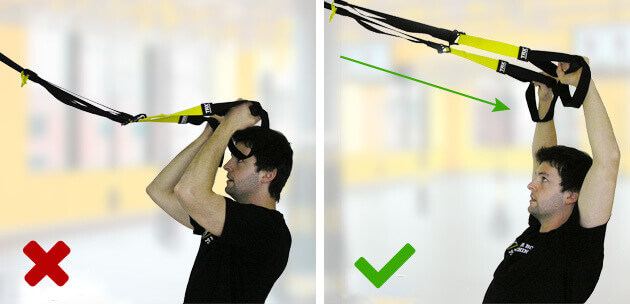
Keep tension on the TRX straps at all times.
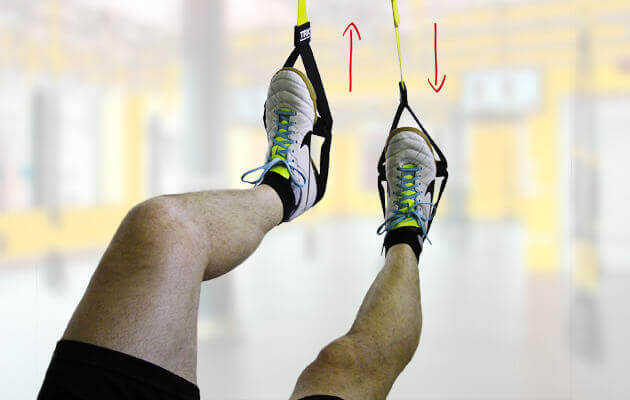
Keep equal pressure on both handles at all times.
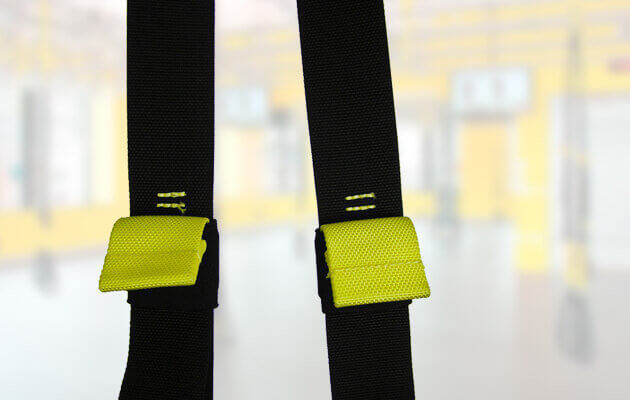
Level the yellow marks on both straps. If they don’t match, one side carries more load.
⚠️ The straps are NOT a pulley. DO NOT perform sawing motions.
Your next four weeks
The plan above is week one. If you run it unchanged for three months, it stops doing anything. Progress it like this — one change at a time, never two at once.
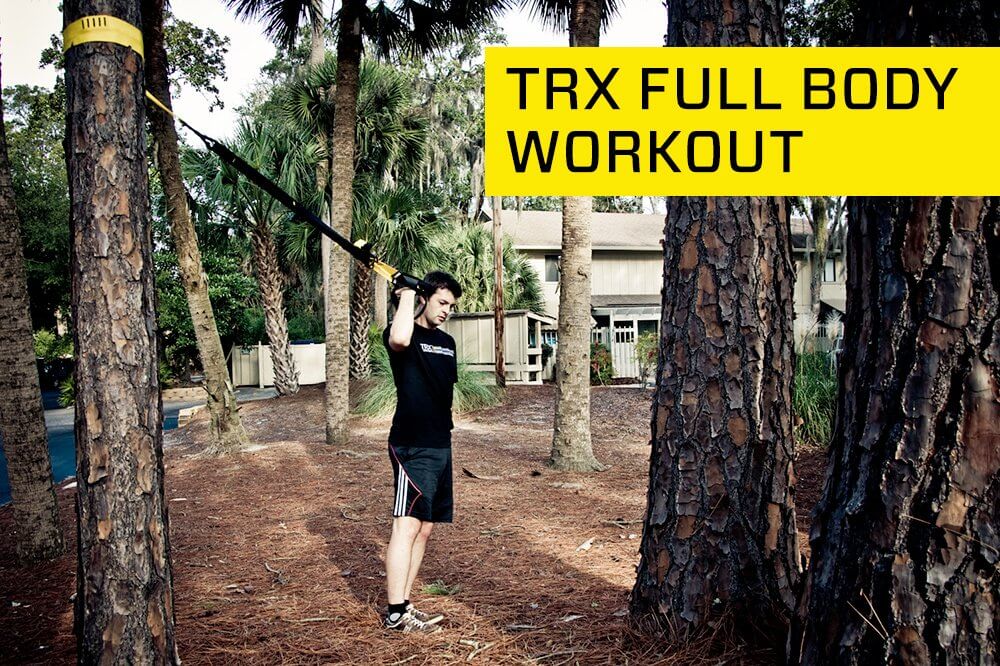
Change one variable a week: first the body angle, then the rest times, then the volume.
| Week | Sessions | What changes | Why |
|---|---|---|---|
| 1 | 2 | Plan exactly as written. 2 rounds, 10 reps, 15 sec rest. | Learn the positions and find your angle for each move |
| 2 | 2–3 | Same reps, same rounds. Move your feet 4 to 6 inches (10–15 cm) closer to the anchor on the standing exercises. | Steeper angle = more load. This is the lever to pull first. |
| 3 | 3 | Keep the new angles. Cut rest from 15 to 10 seconds, and from 1 minute to 45 seconds. | Same work in less time raises the metabolic demand |
| 4 | 3 | Add a third round of each block, or take the harder variation listed under each exercise. | More volume, or more difficulty — pick one, not both |
💡 Train on non-consecutive days. Two solid sessions a week beat four rushed ones. If your technique falls apart in the last round, you’ve progressed too fast — go back a step.
When week four gets comfortable, either restart at week one with a steeper angle across the board, or rotate in different exercises. Browse the full TRX workouts category for what to swap in.
When not to do this workout
Suspension training is adjustable enough for most people, but not everyone should run this plan today.
- Acute or unresolved shoulder, elbow, wrist or lower back injury. Get cleared first. The pressing and overhead moves put the shoulder in loaded ranges.
- Uncontrolled high blood pressure or a recent cardiac event. Head-below-heart positions like the atomic push-up and standing rollout aren’t the place to start.
- Pregnancy. Supine work and deep trunk flexion need modifying. Talk to your provider.
- Dizziness or balance disorders. The single-leg and rotational moves need a stable base.
- An anchor you’re not certain about. If you can’t confirm the anchor point takes far more than your bodyweight, don’t use it. Read the anchoring guide and fix that first.
Sharp pain in a joint means stop the exercise. Muscle burn is fine. Joint pain isn’t.
The gear you need — and 15% off
A suspension trainer is two adjustable straps and a pair of handles. That’s the whole system, and it’s why it fits in a bag and hangs from a door. Any current model runs this plan — the choice is really about where you’ll train and how much wear the straps take. The home models pack down smallest, the tactical models are built tougher for outdoor anchors, and the pro models take commercial use.
The full breakdown is in the TRX Suspension Trainer comparison. If you’re wondering how a suspension trainer stacks up against a cheaper set of bands, read TRX trainers vs resistance training.
Gear I actually use
on any TRX® order — use this code at checkout
TRX15LUKASApplies to all TRX products — suspension trainers, training tools, apparel, education and apps.
TRX® HOME2 SYSTEM
The all-rounder for training at home
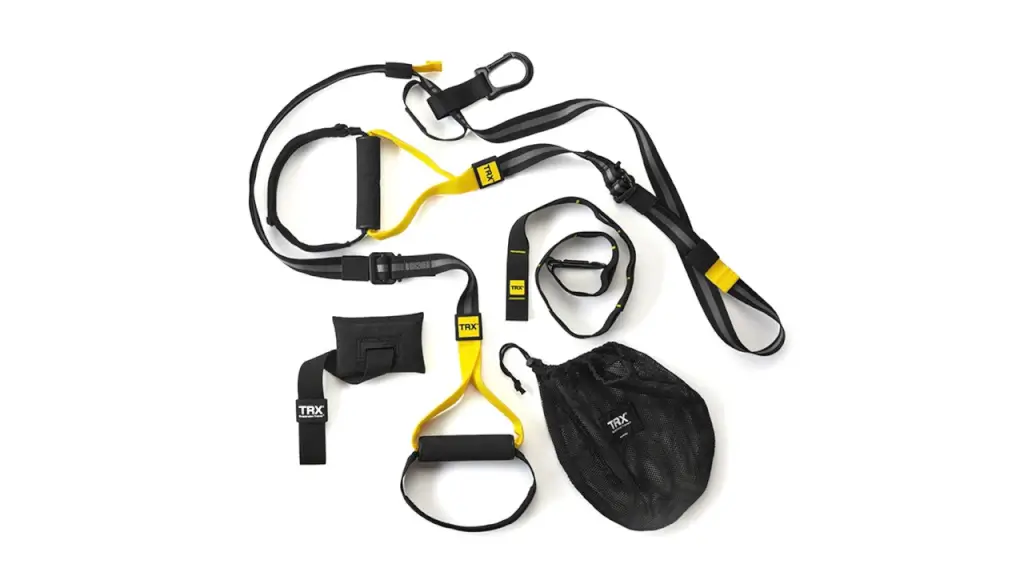
- ✓Door anchor, suspension anchor & mesh bag included
- ✓Free 30-day trial of the TRX App
- ✓Sets up anywhere in seconds, no tools needed
TRX® PRO4 SYSTEM
Built for heavy use and for trainers
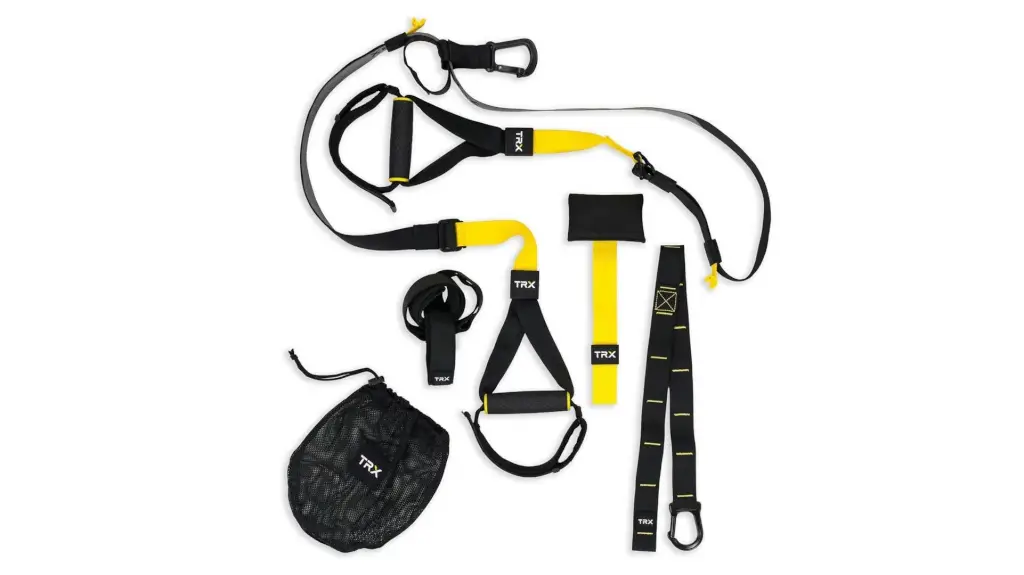
- ✓Door anchor, suspension anchor, Xtender & bag
- ✓Locking carabiner for a secure anchor point
- ✓Rubber handles that resist sweat and friction
TRX App™ Programs
If you have the straps but not a plan
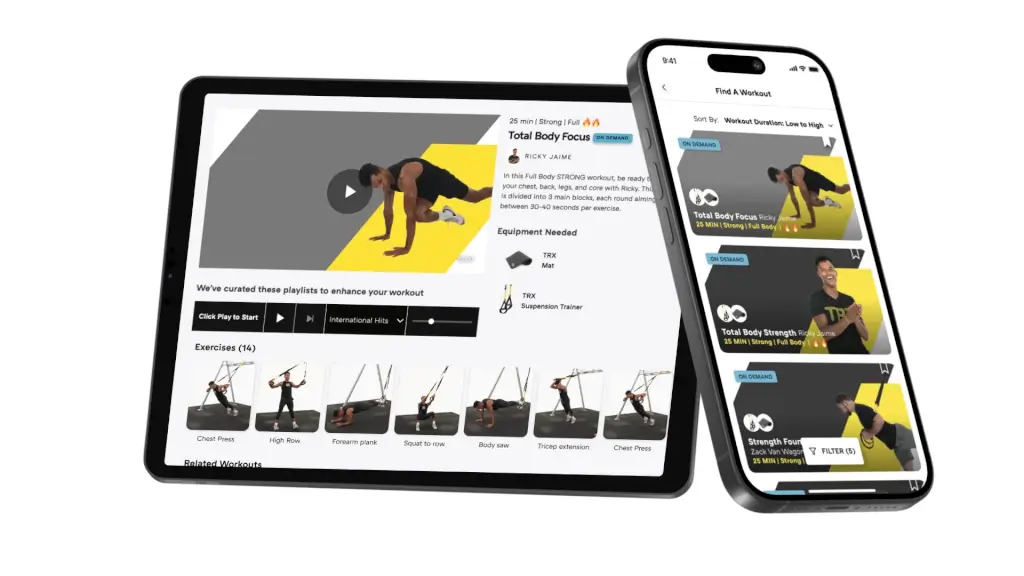
- ✓10+ structured on-demand training programs
- ✓Free 30-day trial, cancel any time
- ✓HSA/FSA eligible
YBell®
Four tools in one, for small spaces
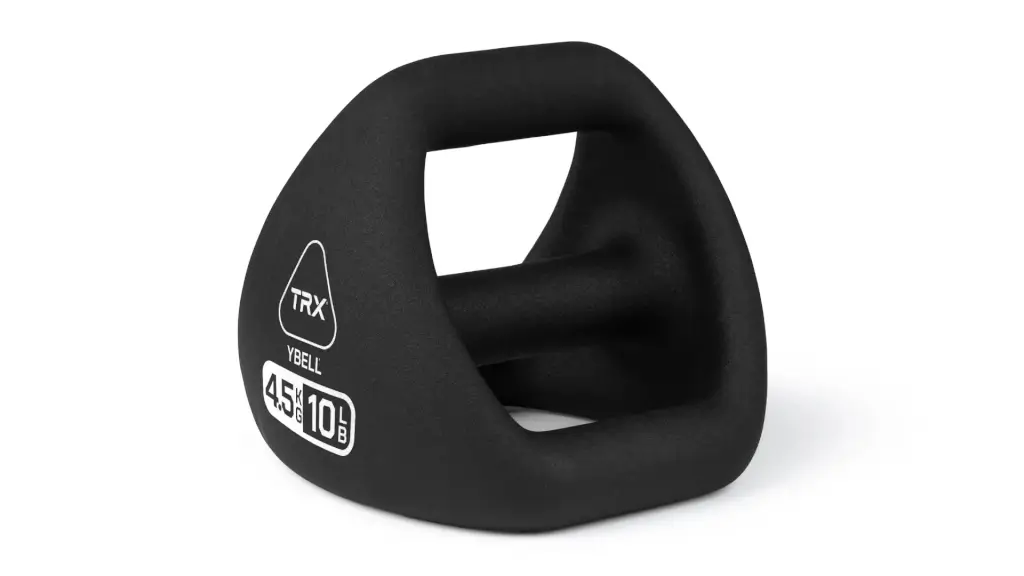
- ✓Dumbbell, kettlebell, med ball and push-up stand
- ✓Neo Series: 2.4–27 lbs (1.1–12 kg)
- ✓Pro Series: 10–44 lbs (4.5–20 kg), 2-year warranty
TRX® RIP TRAINER™
For rotational power and a stronger core
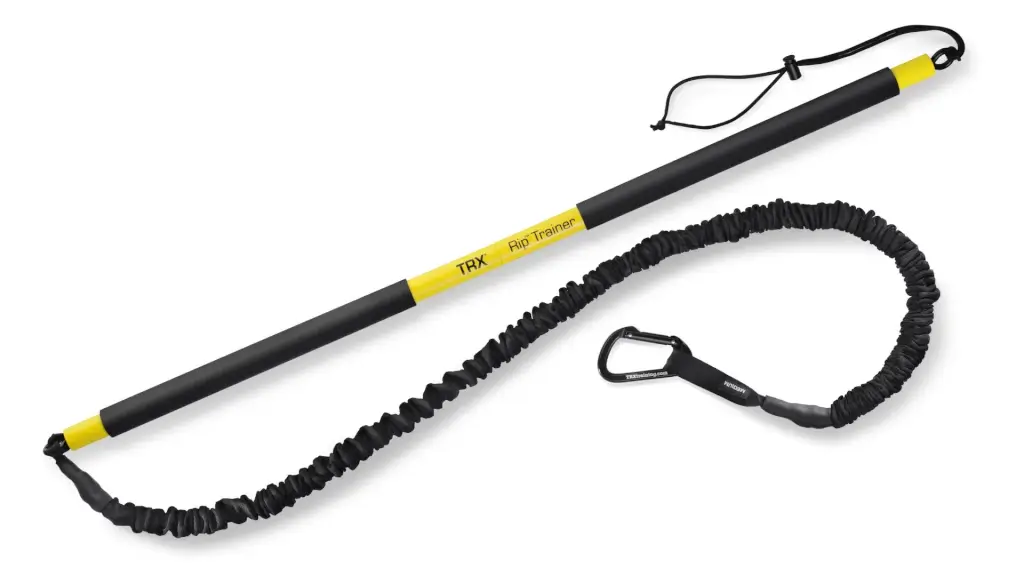
- ✓Door anchor, resistance cord & safety strap included
- ✓Built for rotation — golf, tennis, baseball
- ✓Packs into a backpack, set up in seconds
→ swipe for more
Disclosure: the links above are affiliate links. If you buy through them, I may earn a commission at no extra cost to you — and you still get 15% off with code TRX15LUKAS. I only recommend gear I actually use. Prices and availability are shown on trxtraining.com and can change.
Buy genuine only, and buy online. Counterfeits fail at the stitching and the cam buckle, which is exactly where you don’t want a failure. The counterfeit guide shows you what to look for.
What readers say about this plan
These are real messages from people who downloaded and trained with this 30-minute workout. Thank you for every one of them — I still read them all.
— Lukas Dubina, founder of CoreTrainingTips.com
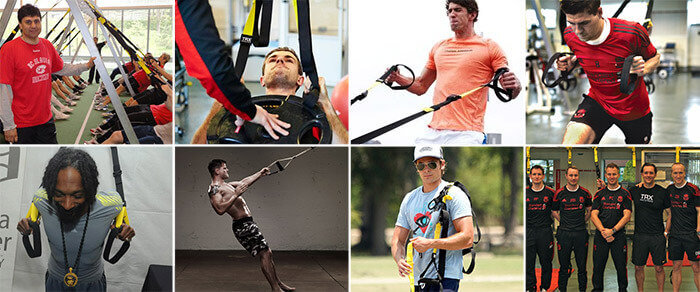
One suspension trainer and one anchor point is all any of these readers needed.
Hi Lukas, I am from Greece and immigrated to UK recently. I have been using TRX for a couple of months last year and started over again now. The PDF is the most helpful guide for home exercise. Thank you very much!!
Dinos
Thank you for your email and yes I did receive and download the workout. I am a triathlete and have been truant for a year by “just” doing the swim, bike, run training and have done no strength or cross training. I recently joined the gym for the first time in 20 years for the pool for winter workouts. As part of that I received a free Personal training session and they exposed me to the TRX bands that I think will have a significant impact on my strength training.
Greg
I downloaded your TRX exercises many thanks for sharing this useful training. I look forward to new TRX exercise trainings…
Ahmet
Thank you Lukas. I have read through your workout plans and they are really helpful to me. I’m a rugby player but have been juggling work and training so a friend helped me with some TRX to help me do my workout at home and same time.
Hubert
Thanks Lukas, I am working out at a gym with TRX among other equipment. I had a personal trainer for 8 years, but had to quit because of a move. He used TRX all the time with me. I wanted to get information about different exercises. Your site seemed to have the best information. I am 70 years of age and retired. I am only interested in strength and balance at this time.
Al McCutchan
Hello Lukas! My name is Pavel. I’m 36 YO Russian. Purchased my TRX about 2 years ago when didn’t have enough opportunities to visit a gym. I was a little bit sceptical about TRX and considered it as additional training devices for trips or busy days. But then realised how difficult workout for TRX can be, I changed my mind. Want to develop a good workout program for me to change the gym with home trainings on TRX (small kids can’t let me train regularly as in the past) to maintain my shape and strength.
Golubev Pavel
Hi. Thank you! I’ve got it! I will be studying a few months aboard in France and I won’t be paying a gym, I only have one TRX at home so this will be really helpful.
Arturo
Hi! Thanks for the email. Yes I got your first email. I actually teach TRX at my local gym, so I am always researching new moves to use during TRX class.
Heidi Cade
Hi my name is Magda, thanks for exercise. I have TRX for a year but now I am planning to start training on it. I’ve been practicing for about 4 years and they are training at the gym and training at home. I have some weights, kettlebell and TRX at home. I hope you understand what I write to you because my English is not very well. I have problems with my back that is why I started do exercise.
Magda
Hi Lukas, I am 56 and just getting into training again and like the TRX straps, looking to do circuits with them found your website, which has give me more of an insight how to use them. Thank you.
Reader message
Hi, Lukas! I’ve recently bought a TRX in order to try to work out from home. Also it’s an attempt in saving some precious cash every month, not paying for a gym. hahaha I’ve done some research on some TRX workouts through Google and yours was the one that caught my attention the most. I’ve only done it 2x so far, I hope I can give you a better feedback soon. Cheers from Sao Paulo, Brazil.
Bruno
I bought the TRX before deploying to Afghanistan, and used it while I was there. I then loaned it to another soldier. Somewhere along the way the manual disappeared. And that’s why I needed a new copy of the workouts.
Dan
I am a 6 ft 0 inch 64-year-old man. I had the goal of completing the hike to The Royal Arch in Boulder, CO with my grandson, Dillon. I had tried three times before when I was out of shape, and had to quit about half way through. I’m glad to say my grandson, my son (his dad), and I made the hike rather easily before winter set in! Having used the TRX system at the gym, I decided to purchase my own, and now have it in my basement suspended from the ceiling.
Scott, Longmont, CO
Hi Lukas, I have printed out the workout and should be receiving my TRX Pro 4 by UPS today. I can’t wait to start.
Kelly
TRX workout plan FAQ
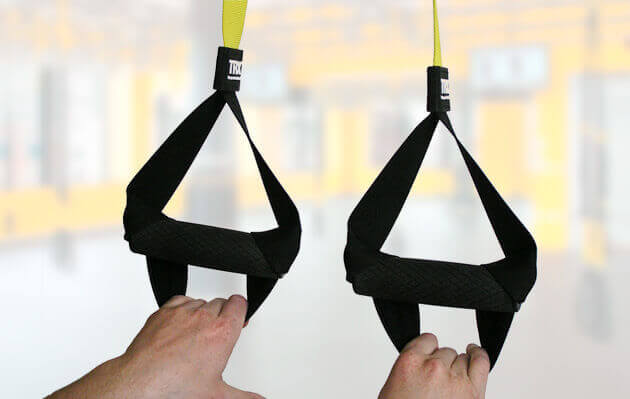
Wrap the cradle around the foam handle twice to shrink the loop.
Start today
You have the plan, the technique for all 15 exercises and a four-week progression. Set the straps, run the warm-up, and take round one at a body angle you can actually control.
↓↓↓ Download the TRX Workout here [PDF] ↓↓↓
Then come back and tell me how it went. The messages above are why this page still gets updated.