

🎁 How to apply the TRX Training Discount Code

Pick a suspension trainer if you want to build strength with your own bodyweight, train your core in every set, and scale difficulty by moving your feet. Pick resistance bands if you need portability, tiny load increments, or resistance in directions gravity cannot give you. But the honest answer is that this was never an either-or question. The two tools load opposite ends of the same movement, and the fastest home setup owns both.
This guide explains what actually separates them — not a list of features, but the physics underneath — and then tells you which one to buy first for your space, your budget and your goals.
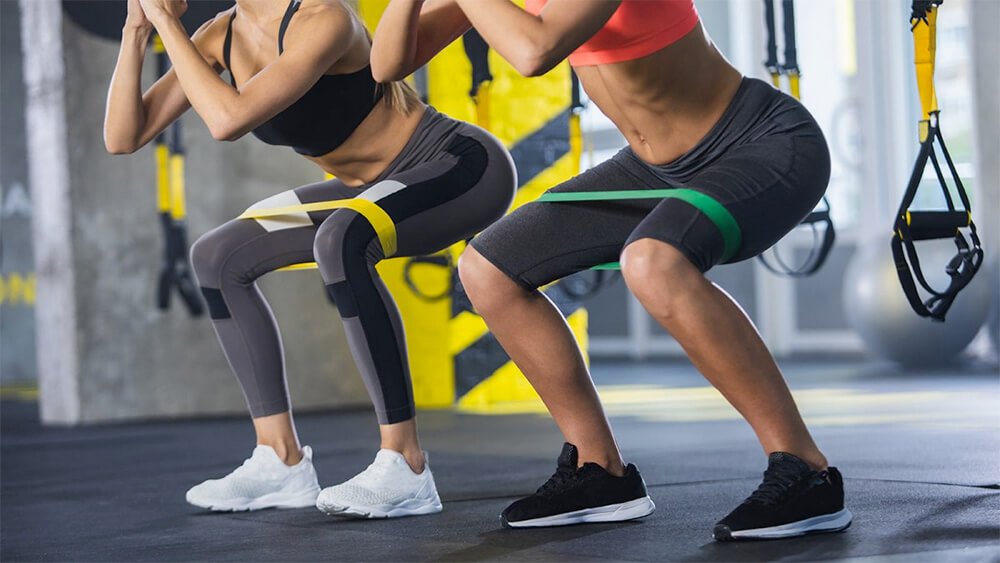
The two tools load opposite ends of the same movement, which is why the comparison keeps ending in a draw.
Who this comparison is for
This is for you if you are setting up a home gym and can only buy one thing right now. It is also for you if you already own one of the two and want to know what the other one adds.
It is not a buying guide for specific models. If you have already decided on straps and just need to pick between them, go straight to the TRX Suspension Trainer comparison. And if you are brand new to the whole concept, start with what TRX Suspension Training actually is.
TRX vs Resistance Bands: The Quick Comparison
| TRX Suspension Trainer | Resistance bands | |
|---|---|---|
| Where the resistance comes from | Gravity acting on your bodyweight, redirected through the straps | Elastic tension in stretched latex or fabric |
| How you add load | Continuously — shuffle your feet toward the anchor and the load rises smoothly | In steps — move to a heavier band, double up, or stand further from the anchor |
| Space needed | About 8 feet long by 6 feet wide (2.4 × 1.8 m) of clear floor | Whatever the exercise needs. A hotel room works |
| Anchor point | Required — 7 to 9 feet (2.1–2.7 m) overhead, load bearing | Optional. Your own foot, a hand, or a door anchor |
| Cost of entry | Higher for one quality trainer | Lower for a starter set |
| Travel | Packs into carry-on, but you need a safe door at the other end | Fits in a jacket pocket. Nothing to find, nothing to trust |
| Durability | Nylon webbing and hardware. Replace when inspection says so, not on a schedule | A consumable. Latex fatigues with UV, heat, oils and repeated stretching |
| Beginner friendly? | Very — you can regress any exercise to almost nothing by standing more upright | Very — the lightest bands are gentler than any bodyweight movement |
- A band stores energy. The further you stretch it, the harder it pulls back. Force rises as the movement goes on.
- A suspension trainer redirects gravity. The straps add no force of their own — they change how much of your bodyweight your muscles have to hold, and that share is set by your body angle.
- Because your body angle changes during a rep, the load on a suspension exercise falls as you finish it.
- Because the band gets longer during a rep, the load on a band exercise rises as you finish it.
Why it works: these are mirror images. One tool is hardest where your muscle is long and stretched, the other is hardest where it is short and contracted. That single sentence explains almost every practical difference on this page — and it is the reason experienced lifters end up using both.
What Is TRX Training?
TRX is a brand of suspension trainer — two adjustable straps hanging from one overhead anchor point, with a handle and a foot cradle at each end. It was developed by former Navy SEAL Randy Hetrick, who built the first version from parachute webbing and a jiu-jitsu belt while deployed.
The brand named the category, and its terminology is now used generically — which is why people say “TRX” when they mean any suspension trainer.
The principle is simple. You hold the handles or put your feet in the cradles, then let part of your bodyweight hang. How much of it your muscles have to control depends on where your feet are relative to the anchor. Move them closer, and the exercise gets harder. Move them back, and it gets easier. TRX calls this the Vector Resistance Principle, and it is the main dial you turn.
There are two more dials. The Pendulum Principle shifts your starting position away from directly under the anchor, so gravity helps in one direction and fights you in the other. The Stability Principle shrinks your base of support — a narrower stance, one leg, one arm — so the same movement demands more from your whole body.
Trainer rule: scale with your feet before you add reps, sets or sessions. A beginner who moves one shoe length forward has just changed the workout more than adding two reps ever would.
Because you hang from a single anchor, the straps are free to swing. Nothing holds you in a groove. That is why every suspension exercise, even a biceps curl, ends up being a trunk exercise too. It is also why you cannot use one without a proper anchor point.
What Is Resistance Training?
Strictly speaking, resistance training means any training against resistance — barbells, machines, your own bodyweight and suspension trainers all qualify. In everyday use, and in the way people search for it, it means training with elastic resistance bands, and that is how we use it here.
Bands started out as a portable substitute for free weights and as a physical therapy tool for low-load rehab work. That history still shows: they are the tool of choice whenever you need very small, very precisely graded resistance.
Two formats dominate. Flat loop bands are continuous rings, used around the knees or ankles, for pull-aparts, and to assist pull-ups. Tube bands have molded handles at each end and usually come with a door anchor. Both are color coded by strength, but the color codes are not standardized — a black band from one brand can be lighter than a red one from another. Read the label, not the color.
The important structural difference from suspension training: the band does not support your bodyweight. It only adds resistance. You can do band work sitting in a chair, lying on your back, or standing on one foot — the band does not care which, because it is not holding you up.
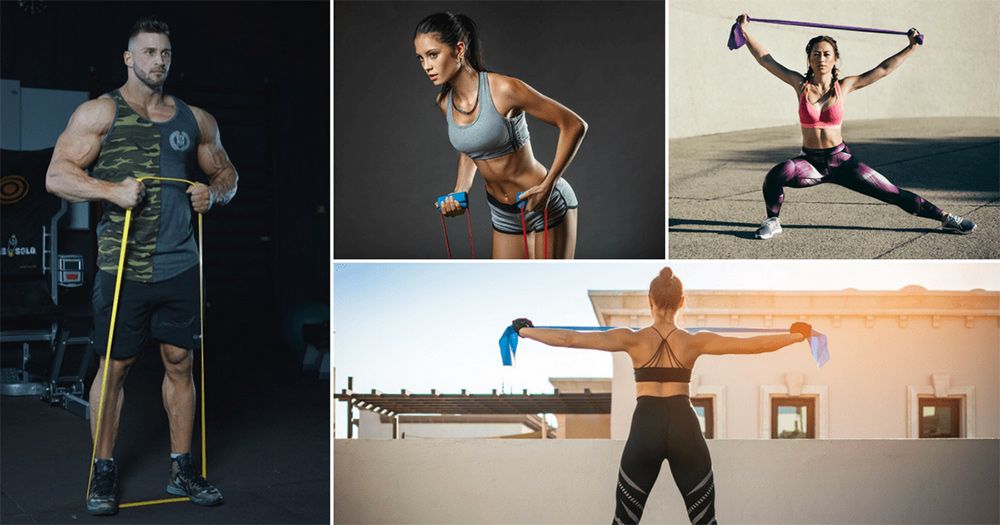
Because the band never carries your bodyweight, you can work seated, lying down or on one foot.
That is also why bands can resist in any direction. Anchor a band at hip height to your left, and it pulls you left. Nothing about gravity can do that.
How the Resistance Curve Differs
This is the section the internet keeps skipping, and it is the whole comparison in one idea.
A band gets harder as you go
Elastic resistance depends on how far the band is stretched. At the start of a movement the band is short and the pull is light. As you finish the rep the band is at its longest and the pull is at its strongest.
Take a biceps curl. With a dumbbell, the load is the same weight all the way up. With a band, it starts easy at the bottom and peaks at the top, right where your biceps is fully shortened.
The upside: the hardest part of the rep lands where your joint is usually in its safest, most stable position. That is exactly why bands became a rehab staple.
The downside: the stretched position — the bottom of the curl, the bottom of a row, the deep part of a squat — gets almost no tension. That is a real part of the range of motion and it is going untrained.
A suspension trainer gets easier as you go
Now do a TRX Row. At the start your arms are extended and your body is at its most horizontal, so your muscles are holding the biggest share of your bodyweight. As you pull yourself in, your body rises toward vertical — and the share of bodyweight you are fighting drops.
So the hardest moment of a suspension row is the start, with your back muscles at their longest. The same is true of the TRX Chest Press: hardest at the bottom with your chest open and stretched, easiest as you come back upright.
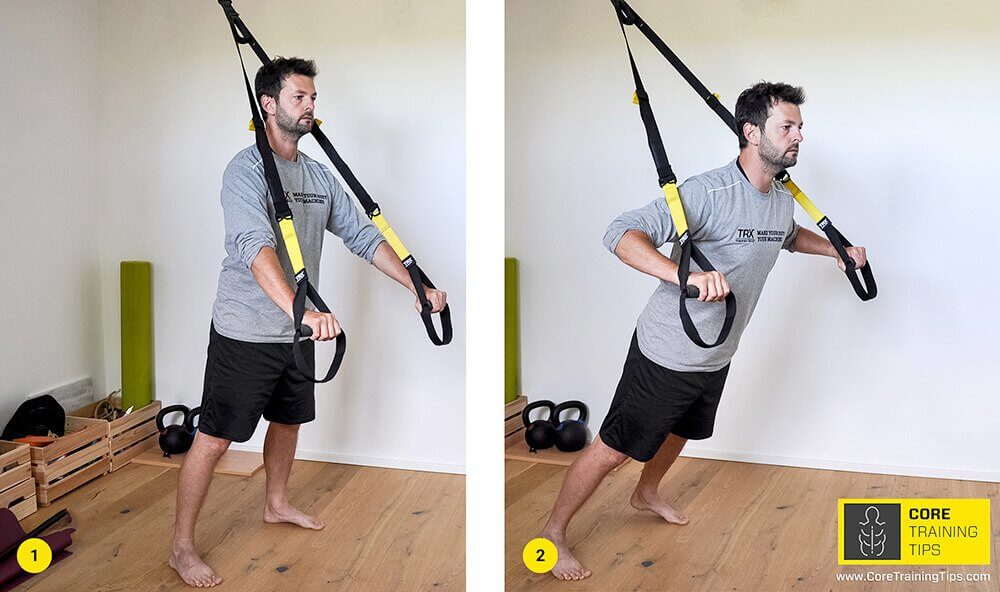
The chest press is hardest at the bottom, with the chest stretched — exactly where a band gives you nothing.
The upside: you load the lengthened position, which is where a band gives you nothing.
The downside: the finish, where you can produce the most force, is the moment the tool is asking the least of you.
Put them next to each other
| Start of the rep (muscle long) | End of the rep (muscle short) | |
|---|---|---|
| Resistance band | Light | Heavy |
| Suspension trainer | Heavy | Light |
Neither curve is right or wrong. They are complementary. Once you see that, the sensible question stops being “which one is better” and becomes “which one do I need first, and what does the other one add.”
Disclosure: This post contains affiliate links. If you buy through them, I may earn a commission at no extra cost to you — and you get 15% off with my code TRX15LUKAS. I only recommend gear I actually use.
Advantages Of TRX Training
1. The load scales with you, automatically
Your bodyweight is the weight stack. As you get stronger and leaner, the exercise adjusts with you. No plates to buy, nothing to outgrow on the upper body.
2. Progression is continuous, not in jumps
This is underrated. Bands step from one resistance level to the next, and that step can be too big — especially for a beginner or for a small muscle group. With straps you slide a foot two inches forward and you have made a change no band set can offer.
3. Your core works in every single set
The straps hang from one point and swing freely, so your trunk has to stabilize the whole time. You do not need a separate ab block to train your midsection when you train this way — though the dedicated core work is still worth doing.
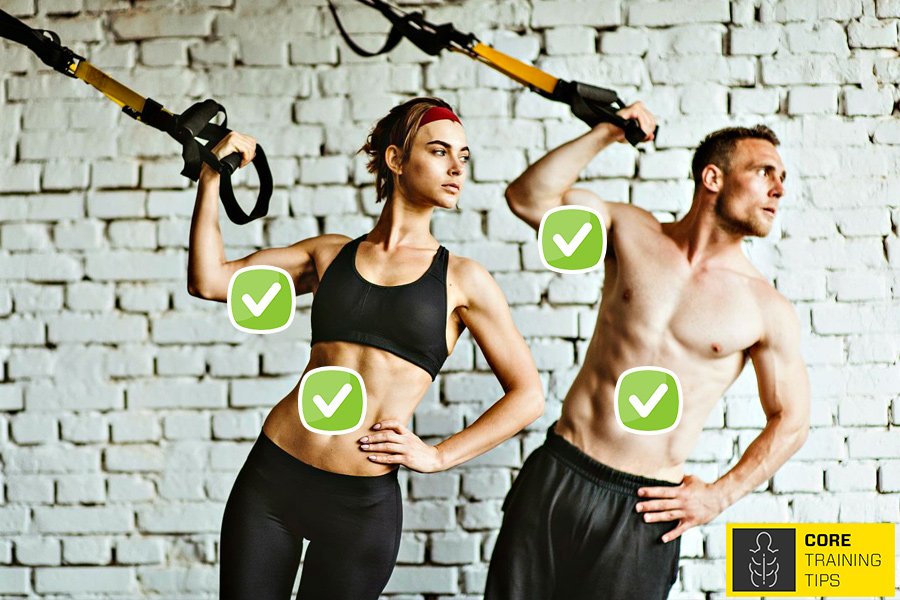
TRX muscles worked while exercising
4. One tool, seven movement patterns
TRX organizes its method around plank, pull, push, hinge, squat, lunge and rotation. One pair of straps covers all seven. That is a genuinely complete training tool hanging from a door.
5. It regresses better than almost anything
Someone who cannot do a single push-up on the floor can do a suspension press standing nearly upright, and progress from there. Same for squats, lunges and rows.
Disadvantages Of TRX Training
1. You need an anchor point, every time
Seven to nine feet (2.1–2.7 m) overhead, load bearing, with the door opening away from you if you use a door anchor. In some rooms and some hotels, that anchor does not exist. There are more solutions than people expect, but it is still a constraint bands do not have.
2. It needs floor space
About 8 feet by 6 feet (2.4 × 1.8 m) clear. Lean back to 45 degrees and if your heels hit the couch, you are not training there.
3. Isolation is hard
Everything is a compound movement with a stabilization tax. That is a feature for general fitness and a problem when you specifically need to load one muscle and spare another. Isolating the triceps is possible, but you will never isolate them the way a cable machine does.
4. The lower body runs out of load fastest
Your legs are strong. A squat where the straps are actually taking weight off you is not a heavy squat. You can push it with tempo, single-leg work and explosive variations, but this is where a suspension trainer hits its ceiling first.
5. Resistance is always tied to gravity
You can only be loaded in directions that involve falling. Pure horizontal resistance — a rotational chop, a lateral walk, a shoulder external rotation against a sideways pull — is not something a strap can give you.
Advantages Of Resistance Training
1. Resistance in any direction
The band pulls along its own line, and you choose that line. Anchor it low, high, behind you, beside you. This is the single biggest thing bands do that suspension trainers cannot, and it covers a lot of shoulder health, hip health and rotational work.
2. True isolation
You can load one muscle at one joint angle with a light, precise resistance and leave everything else alone. Nothing else on this page does that as cheaply.
3. Portability that is hard to argue with
A band coils into a pocket. There is nothing to hang, nothing to inspect, nothing to trust. If your training has to survive airports, that matters.
4. Peak load in the safest position
Tension is highest at peak contraction, where your joint is typically in a strong, stable position. It is why bands earned their place in physical therapy.
5. They add load to things that have run out of it
A band around the knees turns an easy squat into hard work. A band across the back does the same for a push-up. Bands are the cheapest way to make bodyweight exercises harder.
Disadvantages Of Resistance Training
1. Almost nothing in the stretched position
At the start of the movement the band is short and slack. The lengthened position, arguably the part of the range that matters most for building muscle, gets the least tension.
2. Load is hard to reproduce
Band tension depends on how far you stand from the anchor, how you wrapped it and where you grabbed it. Change any of those and today’s set is not comparable to last week’s. You cannot really log it.
3. Jumps between bands are big
Going up a level is often a much bigger step than you actually want. There is no half band.
4. There is a ceiling, and it gets awkward
Heavy bands do provide serious tension, but holding them, anchoring them and controlling them gets unpleasant fast. Anyone who has had a band slip off a door anchor knows why.
5. They wear out, and they fail suddenly
Latex degrades with UV light, heat, oils and repeated stretching. It does not fail gradually like a worn shoe — it snaps. Inspect for nicks, cloudiness and thin spots before every session, and retire anything suspect.
Safety: NEVER stretch a band toward your face, and check the anchor every single time. A band that lets go travels back along the exact line you stretched it.
What Neither Tool Trains Well
Being honest about this is more useful than another list of benefits.
Neither one loads a heavy lower body. If your goal is a serious squat or deadlift, you need external load. Straps cap out at a fraction of your bodyweight and bands go slack in the bottom position — the two failures stack in the same direction.
Neither one gives you a number to chase. There is no plate to add, no logbook line that says 185 lbs (84 kg). Progress has to be tracked another way: body angle, tempo, reps, single-limb versions.
Neither one replaces impact and conditioning. Both are strength tools. For cardiovascular work you still need something that raises your heart rate for a sustained block — a jump rope is the cheapest thing that fits in the same bag.
Neither one replaces mobility work. Both improve control through range. Neither is a substitute for a real stretching routine.
Which One Fits Your Situation?
Small apartment
Suspension trainer, if you have one solid door and can clear 8 by 6 feet (2.4 × 1.8 m). It gives you more training per square foot than anything else that packs into a drawer. If you genuinely cannot clear that floor space, or every door in the place is hollow-core, buy bands and stop worrying about it.
Frequent travel
Bands if the trips are short, straps if you actually train while away. A suspension trainer weighs almost nothing and fits in carry-on, so weight is not the issue — the issue is the door at the other end. Hotel doors are usually fine; conference centers and rentals are a lottery. Many people who travel a lot end up carrying both, because together they still weigh less than a pair of shoes.
Coming back from an injury
Bands first, straps later. Bands let you load tiny amounts, isolate one joint, and work in exactly the direction a clinician asked for. A suspension trainer earns its place later, when you want loaded range of motion and stability work — and it regresses beautifully, which matters when you are rebuilding.
One rule that is not negotiable: your rehab plan comes from the professional treating you, not from an article. If you are working around back pain, read what usually helps a sore lower back as background, then take it to your physical therapist.
Personal trainer with clients
Suspension trainer, comfortably. One tool, a mixed-ability group, no plates to change: the same exercise scales for every client just by where you put their feet. That instant regression is the reason straps show up in so many small-group settings. If you want to teach it properly, TRX runs certification courses.
Keep a set of bands in the bag anyway, for warm-ups, activation and the shoulder work the straps cannot reach.
Tight budget
Buy one good thing, not two cheap ones. A starter band set is the lower entry point and it is a legitimate choice — just accept that bands are a consumable and you will rebuy.
If you are stretching for straps, spend the money once. A cheap knockoff is exactly the wrong place to save, because the failure point is the webbing and the stitching, above your head, with your bodyweight on it. Here is how to tell a genuine TRX from a counterfeit — and my 15% discount code closes most of the price gap.
How to Use TRX and Resistance Bands Together
Here is the part almost nobody writes, and it is the reason this article exists.
Because the two resistance curves are mirror images, pairing them covers the whole range of motion. There are four ways to do it, in order of how much they will actually change your training.
1. Pair opposite curves in a superset
Do a TRX Row, then immediately a band pull-apart. The strap loaded the stretched position; the band loads the contracted one. Same muscles, both ends of the curve, one superset. Do the same with the TRX Chest Press followed by a banded push-up.
2. Use bands where gravity cannot reach
Lateral walks, rotational chops, shoulder external rotation, hip abduction. None of these have a good suspension version, because the resistance would have to run sideways. This is the biggest genuine gap the bands fill.
3. Use bands to add load where the straps ran out
Mostly the lower body. A loop band above the knees during a TRX Squat gives your glutes something to fight that your bodyweight alone no longer does.
4. Use bands to warm up for the straps
Pull-aparts and band dislocates before pressing, glute activation before squats and lunges. Two minutes of band work makes the strap session better. It is the cheapest upgrade on this list.

Dynamic warm up exercises using TRX Suspension Trainer
A 30-minute session that uses both
Rest 45 to 60 seconds between exercises. Straps are set to the length listed in the last column.
| Block | Exercise | Sets × reps | Strap length |
|---|---|---|---|
| Warm-up | Band pull-apart | 2 × 15 | — |
| Warm-up | Lateral band walk | 2 × 12 each way | — |
| A1 | TRX Row | 3 × 10–12 | Fully shortened |
| A2 | Band row or pull-apart | 3 × 15 | — |
| B1 | TRX Chest Press | 3 × 8–12 | Fully lengthened |
| B2 | Banded push-up | 3 × 8–12 | — |
| C1 | TRX Squat | 3 × 12–15 | Mid-length |
| C2 | Banded glute bridge | 3 × 15 | — |
| D1 | TRX Hamstring Curl | 3 × 10 | Mid-calf |
| D2 | Band rotational chop | 3 × 10 each side | — |
| Finisher | TRX Plank | 3 × 30–45 seconds | Mid-calf |
Progression rule: on the strap exercises, walk your feet toward the anchor before you add reps. On the band exercises, step further from the anchor before you jump to a heavier band. Both give you a smaller increment than the obvious change would.
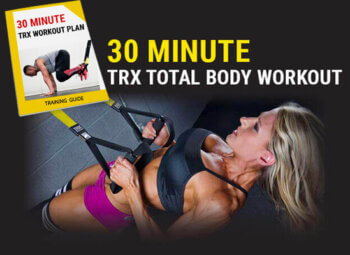
Want a straps-only version to alternate with? Try the 30-minute full-body TRX plan — there is a free PDF with it.
What to buy and how to get 15% off
If you are going with straps, get the model right before you get the discount. The TRX model comparison covers what comes in each box, which ones include an Xtender, and which one is actually worth the extra money for a home setup.
Then use code TRX15LUKAS at checkout. It takes 15% off anything TRX sells — Suspension Trainers, accessories, apparel, apps and education courses — and it is not tied to a sale or a season. Here is how to apply the TRX discount code and check the current price. 🎁
Gear I actually use
on any TRX® order — use this code at checkout
TRX15LUKASApplies to all TRX products — suspension trainers, training tools, apparel, education and apps.
Swipe or scroll sideways for more picks →
TRX® HOME2 SYSTEM
The all-rounder for training at home
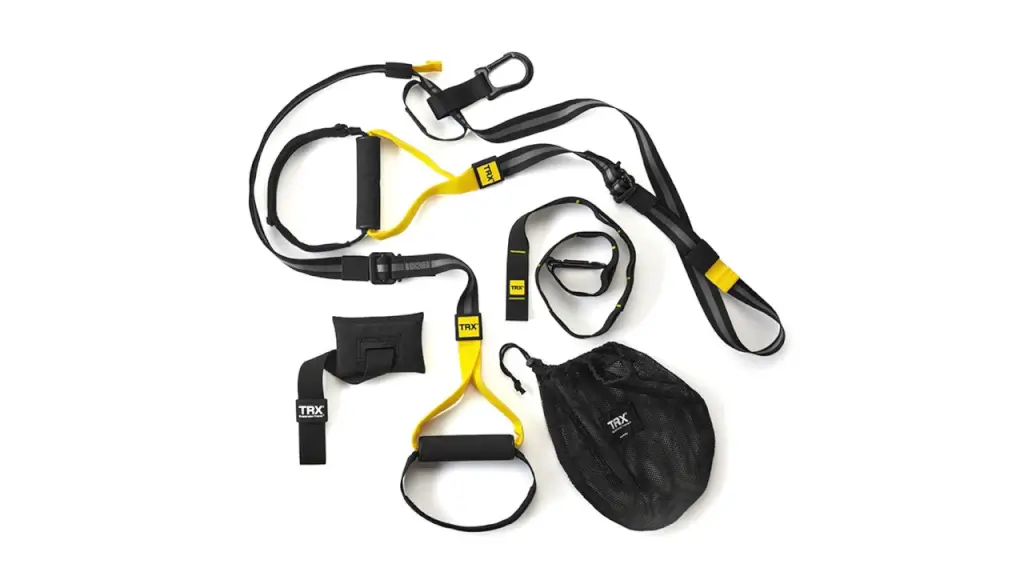
- ✓Door anchor, suspension anchor & mesh bag included
- ✓Free 30-day trial of the TRX App
- ✓Sets up anywhere in seconds, no tools needed
TRX® PRO4 SYSTEM
Built for heavy use and for trainers
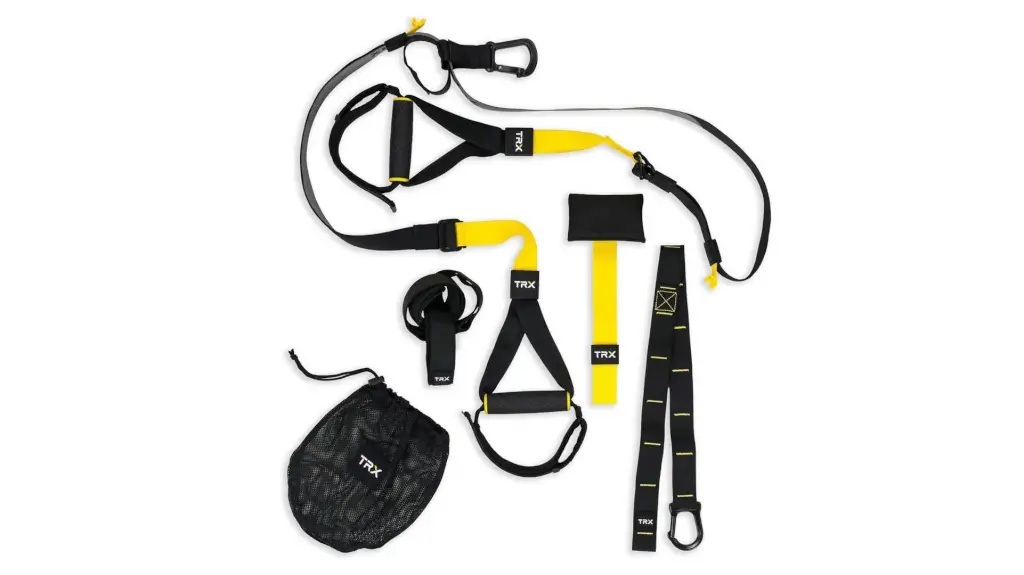
- ✓Door anchor, suspension anchor, Xtender & bag
- ✓Locking carabiner for a secure anchor point
- ✓Rubber handles that resist sweat and friction
TRX App™ Programs
If you have the straps but not a plan
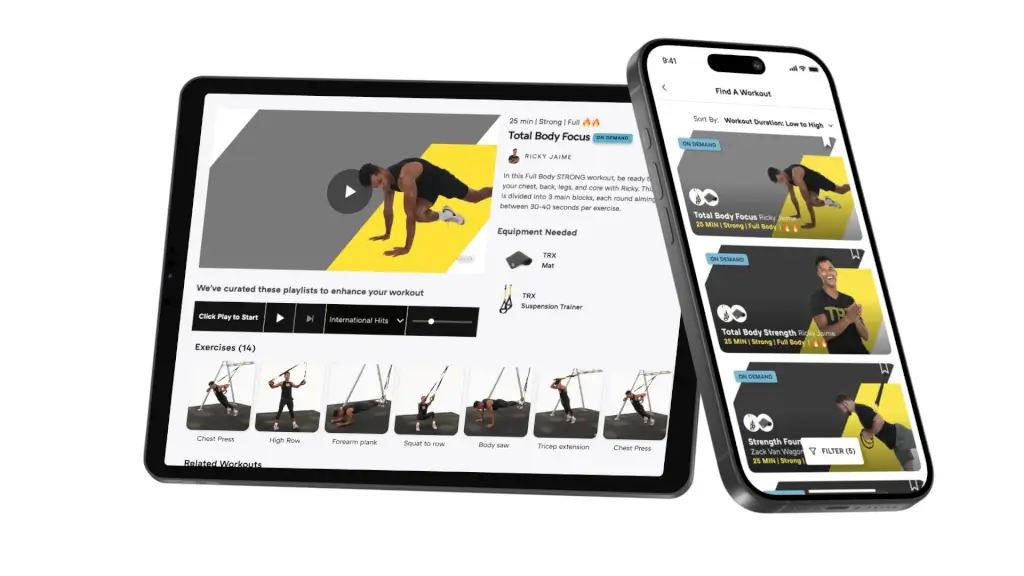
- ✓10+ structured on-demand training programs
- ✓Free 30-day trial, cancel any time
- ✓HSA/FSA eligible
YBell®
Four tools in one, for small spaces
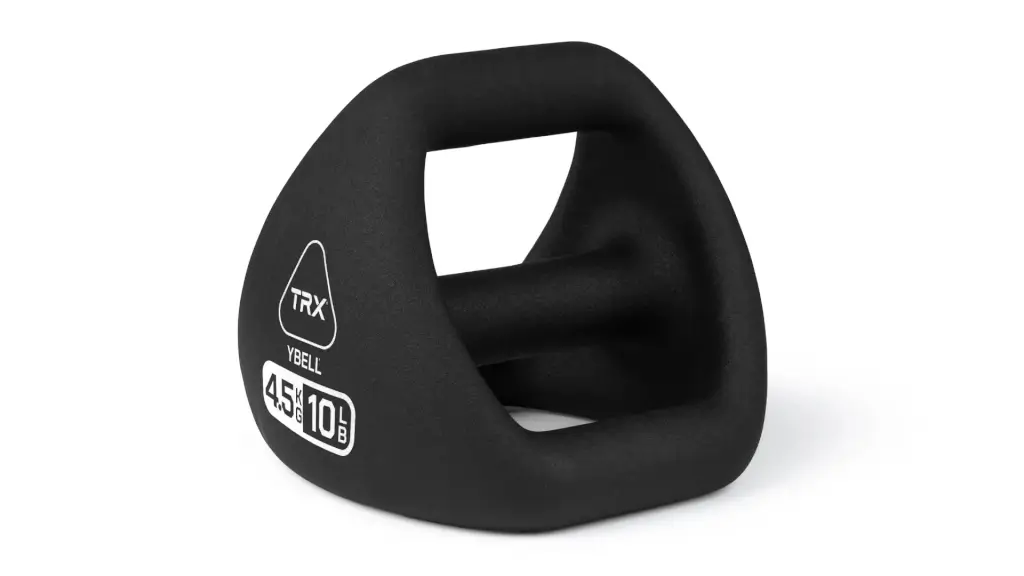
- ✓Dumbbell, kettlebell, med ball and push-up stand
- ✓Neo Series: 2.4–27 lbs (1.1–12 kg)
- ✓Pro Series: 10–44 lbs (4.5–20 kg), 2-year warranty
TRX® RIP TRAINER™
For rotational power and a stronger core
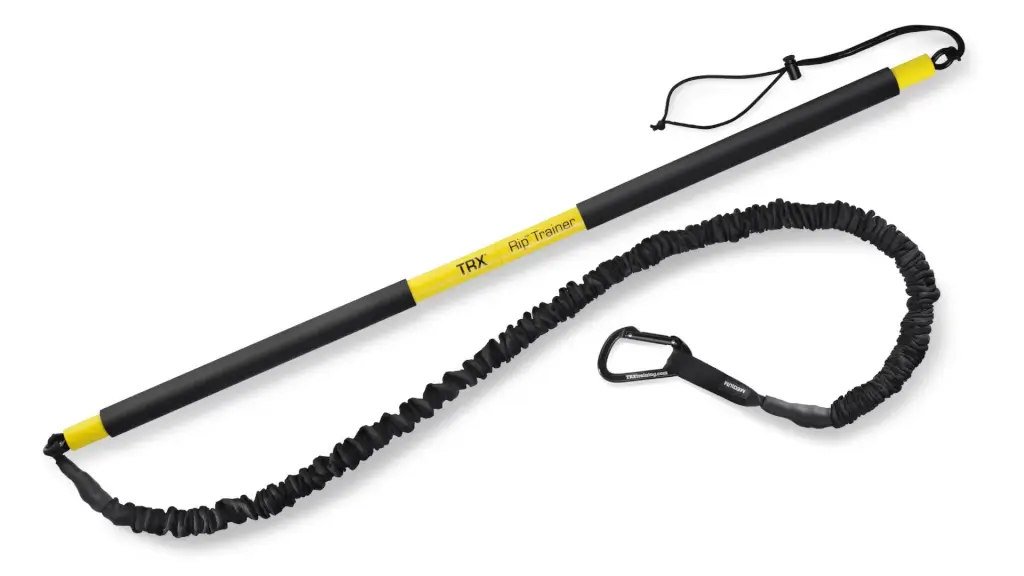
- ✓Door anchor, resistance cord & safety strap included
- ✓Built for rotation — golf, tennis, baseball
- ✓Packs into a backpack, set up in seconds
Disclosure: the links above are affiliate links. If you buy through them, I may earn a commission at no extra cost to you — and you still get 15% off with code TRX15LUKAS. I only recommend gear I actually use. Prices and availability are shown on trxtraining.com and can change.
For bands, buy a set with a range of resistances rather than one band, and keep them out of direct sunlight. Any competent set will do — this is not a category where the brand decides the outcome.
Conclusion
Both tools work. They just work differently, and now you know exactly how: the band is hardest where your muscle is short, the strap is hardest where your muscle is long.
If you want one answer: most people building a home gym should buy the suspension trainer first, because it trains seven movement patterns, scales in tiny increments and makes your core work in every set. Add a band set later for the sideways work, the shoulder health and the lower body load the straps cannot deliver.
Go the other way if you travel constantly, if you have no usable anchor point, or if you are rebuilding after an injury and need small graded loads. Then straps become the upgrade, not the starting point.
Try one session from the combined plan above before you decide either tool is not for you. Most people are surprised by which half was harder.